Alibaba opens Qwen4-Max preview: 1M-token context, native vision, retired on 25 November
Alibaba opened a preview of its new Qwen4 flagship on 11 November: a 1M-token context, up to 393,216 output tokens, text, image and video input, and thinking on by default. Alibaba's own evaluation claims 24 to 49% fewer tokens and average cost per task down from $4.43 to $1.67. The preview is retired on 25 November.
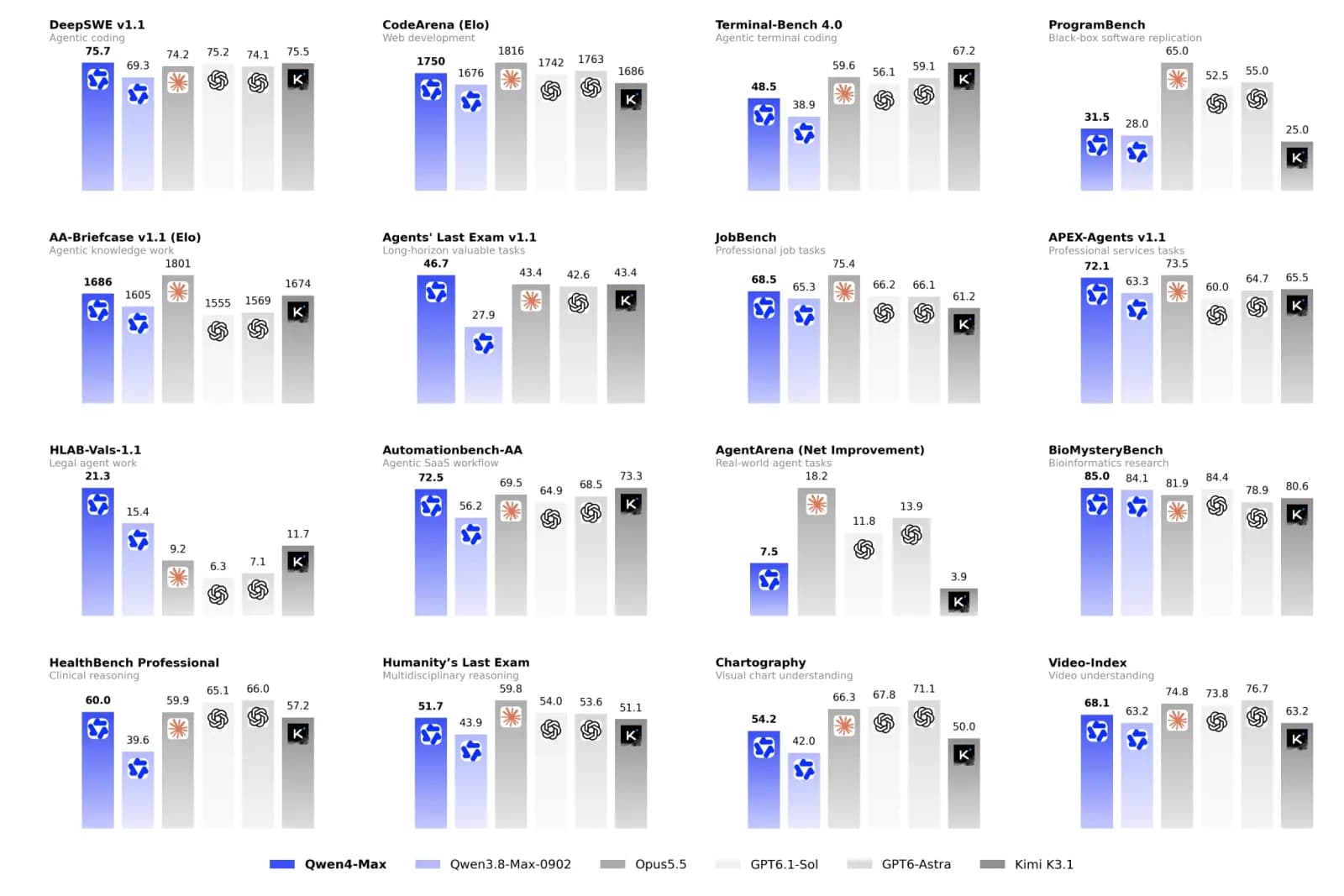
What happened
Summary of reporting by Alibaba Qwen (X)On 11 November Alibaba opened a preview of Qwen4-Max, the first model of its Qwen4 generation and the new flagship of the Qwen family. The model runs under the ID qwen4-max-preview: a 1M-token context, up to 393,216 output tokens, text, image and video input, and thinking on by default. It speaks OpenAI- and Anthropic-compatible APIs, and at launch it was reachable only through Alibaba's Token Plan subscription and inside QwenWork, Qoder, the Qwen app and QwenStudio. Alibaba's documentation states the preview runs from 10:00 on 11 November to 24:00 on 25 November 2026 (UTC+8), after which the model is retired. Reporting: TechNode, https://technode.com/2026/11/11/alibaba-opens-qwen4-max-preview-with-a-million-token-context-window/
On 16 November Qwen's account on X published the first performance and efficiency numbers. The post describes the architecture as a new mixture-of-experts (MoE) design with native vision, and reports 52.69 on Work360, a new internal benchmark spanning 26 Tier-1 domains, about 10% above Qwen3.8-Max. Token efficiency claims: 24% fewer tokens on Work360 at xhigh effort, 35% fewer at high, and roughly 48 to 49% fewer on Terminal-Bench 4.0. Average cost per task in that evaluation falls from $4.43 to $1.67. Source: https://x.com/Alibaba_Qwen/status/2122148127520289151
Every efficiency figure is Alibaba's own. The benchmark is internal, and no open weights or public API pricing had been published with the launch, so Qwen4-Max remains closed. Treat the scores and the cost-per-task drop as vendor claims until they are reproduced on real work.
The Azrty take
Qwen4-Max is a real cost-per-task step, but the preview dies on 25 November and the only benchmark that counts is your own.
The so what for your budget is cost per task, not price per million tokens. Alibaba's internal evaluation puts average cost per task at $1.67 for Qwen4-Max against $4.43 for Qwen3.8-Max, on the back of 24% fewer tokens on Work360 at xhigh effort and about 48 to 49% fewer on Terminal-Bench 4.0. For GCC teams running agentic coding, contract review or long-document extraction, token efficiency is the lever that decides whether the AI line item fits an existing budget or needs a new conversation every quarter. The 1M-token context and 393,216-token output ceiling also mean a full contract pack, or a large one-shot code change, can go through in a single pass.
Where teams will get this wrong first is evidence quality and lifecycle. Work360 is Alibaba's own benchmark, built in-house across 26 Tier-1 domains, and the numbers were published on Qwen's X account. The figures are the vendor's own; nothing independent accompanies them. Meanwhile the model you can call today has an expiry date: the Model Studio documentation retires qwen4-max-preview after 25 November (UTC+8), and the API compatibility changelog records what changes with this model: from qwen4-max-preview onward, max_tokens is equivalent to max_completion_tokens, so thinking and the final answer draw on one output budget. Anyone who hardcoded that ID into an agent, a CI job or an automation breaks the following week.
How we would approach it: put every model behind an OpenAI-compatible gateway (we use FastLLM Proxy, which keeps routing, budgets and access control in one place) and pin the model ID at the gateway rather than in application code, so a retirement is a config change and not a release. Log tokens and wall time per task from day one, so cost per task is measured on your own work in dirhams. Access is the second constraint: Token Plan is a subscription billed in Credits for interactive use in compatible tools, not a pay-as-you-go API, and the international endpoint sits in Singapore (token-plan.ap-southeast-1.maas.aliyuncs.com). With thinking on by default, output spend includes reasoning, so size output budgets against real tasks instead of a vendor chart.
import os
from openai import OpenAI
FastLLM Proxy in front of the provider: pin the model ID at the gateway client = OpenAI(base_url="https://llm-gateway.internal/v1", api_key=os.environ["GATEWAY_KEY"])
resp = client.chat.completions.create( model="qwen4-max-preview", # retired after 25 Nov 2026 (UTC+8) messages=[{ "role": "user", "content": [ {"type": "text", "text": "List every material clause change in this contract pack."}, {"type": "image_url", "image_url": {"url": "https://files.internal/pack/page-001.png"}}, ], }], )
print(resp.usage.total_tokens) # tokens times your rate card is your real unit of account
For UAE and GCC organisations the fork is the data path, not the model. The preview is served through Alibaba's Token Plan, so prompts, documents and video sit in Alibaba's cloud rather than yours, and the international endpoint resolves to Singapore; anything carrying personal or regulated data needs classification under your PDPL obligations before it goes near it. Qwen4-Max stays closed, so self-hosting the Max tier is not on the table as things stand. What is open is the architecture underneath it: Qwen3.8-Flash-Next, which Qwen describes as an early preview of the architecture used in Qwen4, is a multimodal MoE with 125B parameters and 6B activated per token plus 51B of N-gram embeddings. If residency rules force you onto your own GPUs, the same cost-per-task discipline applies to what you run yourself (we run that layer with Kuvryn AI). The organisations that gain from this will run a short bake-off on their own backlog, instrument tokens per task in dirhams, pin models at the gateway and settle the data path before scaling. That evaluation, and the deployment behind it, is what our team in the UAE does.
What to do now
- Run a bake-off inside the preview window: 20 to 50 real tasks (coding, contract review, document and video understanding) through `qwen4-max-preview` on the Token Plan and through your current production model, logging tokens, wall time and reviewer time per task. Treat Work360's 52.69 and the $4.43 to $1.67 figures as vendor data until you reproduce them.
- If anything pins `qwen4-max-preview`, plan the swap now: it is retired after 25 November 2026 (UTC+8). Pin model IDs at a gateway such as FastLLM Proxy rather than in application code, and keep a named fallback ready.
- Log `usage.total_tokens` and wall time per task for every model you run, and compare on the same tasks. A token-efficiency claim only becomes a budget line when it is measured in dirhams on your own backlog.
- Settle the data path first: the preview is served through Alibaba's Token Plan, whose international endpoint sits in Singapore, so classify what documents, images and video may leave the UAE or KSA under your PDPL obligations, and decide hosted versus self-hosted before production traffic.
- Remember the output budget change when you set limits: from `qwen4-max-preview` onward `max_tokens` equals `max_completion_tokens`, so thinking and the answer share one ceiling and a limit sized for the answer alone will truncate.