Dubai RTA's updated AI strategy: 41 areas, 40 AI products, agentic services wired into UAE PASS and Dubai Pay
Mahboub has been upgraded to complete five vehicle licensing services end to end, and an agentic auditor now checks 100% of licensing documents instead of a sample. The published targets are operational: congestion, complaint handling, waiting times and accident rates.
What happened
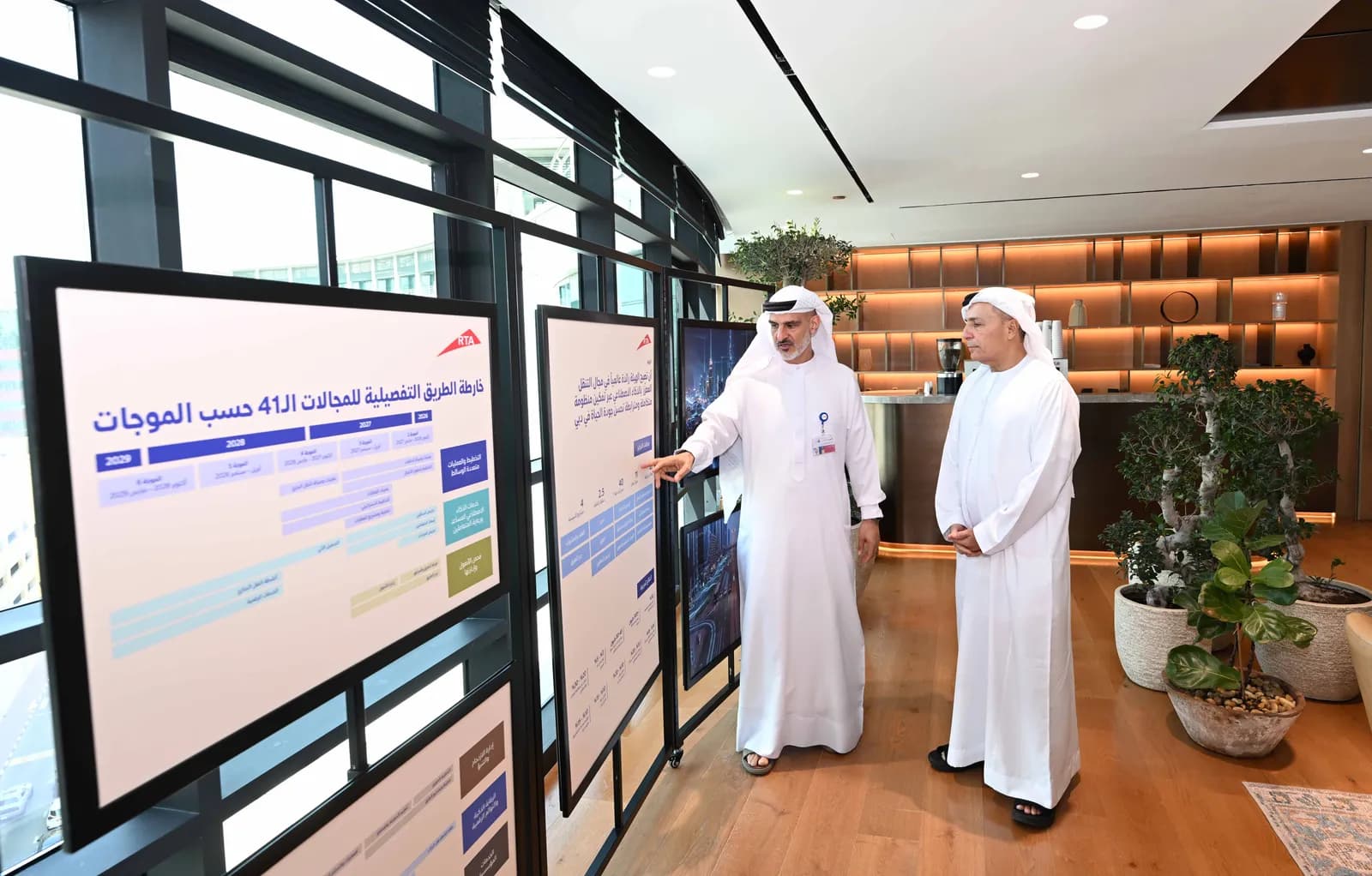
Summary of reporting by WAM / RTA Media OfficeDubai's Roads and Transport Authority (RTA) launched an updated AI Strategy on 1 November. Announced by Director General Mattar Al Tayer, it spans 41 areas with 40 AI products and four foundational projects over a two-and-a-half-year implementation period. Eleven of the products are already complete. The targets are operational rather than aspirational: up to 5% less traffic congestion, 30% faster complaint handling, 14% to 16% shorter waiting times at service centres, and 10% to 20% fewer accidents involving newly licensed drivers.
The consumer-facing centrepiece is Mahboub, RTA's assistant, upgraded with agentic capability so it can complete five vehicle licensing services end to end through the app, the website and WhatsApp. It reaches about 100 information services, is verified through UAE PASS, and settles payments on Dubai Pay.
“The strategy marks an advanced stage in RTA's digital transformation journey, paving the way for a fundamental shift from AI applications that support operations to intelligent systems capable of analysing data, predicting outcomes, supporting decision-making and delivering end-to-end services.”
Mattar Al Tayer, Director General, Chairman of the Board of Executive Directors, Roads and Transport Authority, launching RTA's updated AI Strategy
An Agentic AI Auditor uses machine learning and optical character recognition over licensing documents, moving from sample-based checks to what RTA describes as 100% coverage, up to 21 times faster, with more than 25,000 hours saved a year. A bus network planning system built on about 20 AI agents is intended to cut service-change implementation from roughly 60 days to 48. Reporting: Khaleej Times (https://www.khaleejtimes.com/uae/dubai-rta-targets-traffic-congestion-cut-ai-strategy), WAM / RTA Media Office (https://mediaoffice.ae/en/news/2026/novemebr/01-11/al-tayer-launches-rta-updated-ai-strategy), Gulf News (https://gulfnews.com/uae/dubai-motorists-to-face-less-traffic-and-get-faster-rta-services-heres-how-1.500731525) and Arabian Business (https://www.arabianbusiness.com/business/transport/dubai-targets-5-cut-in-traffic-congestion-with-new-ai-strategy).
The Azrty take
RTA is publishing a reference architecture for agentic government in the GCC: identity, payments and full-coverage audit, not a better chatbot
Read the strategy as an architecture document rather than an announcement. RTA has committed to 40 AI products (11 shipped) and four foundational projects across 41 areas in two and a half years, and tied them to operational metrics: congestion, complaint handling, waiting times, accident rates, hours saved. For any GCC organisation running high-volume services, whether utilities, licensing, ports, municipalities or telcos, that is now the internal bar. If your 2027 AI roadmap has no equivalent table of measured outcomes and no baseline measured before build, it is a wish list, not a strategy. The NIST AI Risk Management Framework (https://www.nist.gov/publications/artificial-intelligence-risk-management-framework-ai-rmf-10) is the voluntary, non-sector specific reference governance teams cite for managing the risks of AI systems across design, development, deployment and use.
Two products show where the value actually sits. Mahboub has moved from answering questions to completing transactions: five vehicle licensing services end to end across app, web and WhatsApp, about 100 information services, identity through UAE PASS and payments on Dubai Pay. Neither rail is bespoke. UAE PASS publishes its service provider integration guide for OAuth 2.0 authentication and digital signature (https://docs.uaepass.ae/overview), and DubaiPay is documented by Digital Dubai as a shared, Dubai Government owned gateway, PCI DSS and ISO 27001 compliant, offered to entities through websites, kiosks and apps (https://www.digitaldubai.ae/apps-services/details/dubaipay). The less glamorous product is the Agentic AI Auditor: machine learning plus optical character recognition over licensing documents, replacing sample-based checks with what RTA describes as 100% coverage, up to 21 times faster, and more than 25,000 hours saved annually. That is the pattern to copy, because an agent can deliver complete regulatory coverage that a human team could only ever achieve on a sample. RTA's own launch release is here (https://mediaoffice.ae/en/news/2026/novemebr/01-11/al-tayer-launches-rta-updated-ai-strategy), with further reporting from Khaleej Times (https://www.khaleejtimes.com/uae/dubai-rta-targets-traffic-congestion-cut-ai-strategy) and Gulf News (https://gulfnews.com/uae/dubai-motorists-to-face-less-traffic-and-get-faster-rta-services-heres-how-1.500731525).
Where most teams in the region will get this wrong is buying "agents" as a chatbot upgrade and leaving the transaction plumbing untouched. RTA's two other signals are the guardrails it did not skip. The bus network planner runs about 20 agents and still shortens service-change implementation from roughly 60 days to 48, which is a planning system with humans deciding. And every transaction that completes itself does so because a payment rail and a national identity provider were integrated first. Model choice is the cheap part of this.
How Azrty would approach the technical work. Treat each service as a transactional workflow, not a prompt. Put an OpenAI-compatible gateway in front of your own LLM servers and hosted providers for routing, per-agent budgets and access control (our FastLLM Proxy does exactly this). Orchestrate multi-step work with a human approval gate at every state-changing step, such as a payment or a write to the licensing record (Dhole is our workflow engine for that shape of work, with a person approving where it matters). Run code-changing agents in isolated runs with quality gates, and log at full coverage, because an auditor that samples is the thing the Agentic AI Auditor replaces. Our team in the UAE designs, deploys and supports this stack. One journey, sketched the way we would define it:
# Illustrative pattern: a single agentic service journey
journey: vehicle_registration_renewal
identity: { provider: uae-pass, step_up: required }
payment:  { provider: dubai-pay, human_approval: on }   # money moves only with a person in the loop
agent:
  routing: route_by_task        # small model for extraction, strong model for planning
  budget: { per_task: set, daily_cap: set }
  tools: [fines.lookup, fines.pay, registration.renew]
  memory: { scope: per_customer }
audit:
  coverage: 100                 # percent of documents and tool calls, not a sample
  log: [prompt, tool_call, artefact_hash, approver_id]
sla: { human_handoff_rate_max: set }
The GCC opportunity is to be second and smarter. RTA absorbed the integration risk on identity and payments and published its outcome ranges, so your organisation can copy the sequencing instead of funding the discovery. The risk is a board reading 40 AI products and four foundational projects as licence to let agents write to systems of record with no idempotency keys, no rollback and no approval gate. The IETF HTTPAPI working group is still standardising the header for that first item (https://datatracker.ietf.org/doc/draft-ietf-httpapi-idempotency-key-header/), and its implementation status records Stripe and Adyen on the exact header and PayPal on its own PayPal-Request-Id. Do that once at payment or licensing scale and the programme dies in a governance review. Match RTA's order of work: full-coverage auditing and back-office reconciliation first, citizen-facing transactions second, and every claim tied to a metric you measured before build.
What to do now
- Baseline one high-volume journey this month (complaints, permits, invoicing) against the metrics RTA publishes for itself: processing time, human handoff rate, and hours per 1,000 cases. Measure before build, not after.
- Put an OpenAI-compatible gateway such as FastLLM Proxy in front of every model and agent, with per-agent budgets and access control enabled, and log every prompt and tool call at 100% coverage so audits are full-coverage rather than sampled.
- Before any agent gets write access to a system of record, route its work through an orchestrator with a human approval gate at the state-changing step (Dhole or equivalent), with idempotency keys and rollback enabled.
- Map identity and payment integration first. Wire UAE PASS (or your enterprise IAM) and your payment gateway into the journey design before any prompt work starts: RTA's end-to-end transactions exist because those two were integrated, not because of the model.
- Keep humans deciding in planning systems. Copy the bus planner pattern (agents draft and analyse, people approve service changes) rather than letting agents publish changes to operational schedules unreviewed.