GPT-6 and Intelligent UI reach ChatGPT users as answers become interfaces
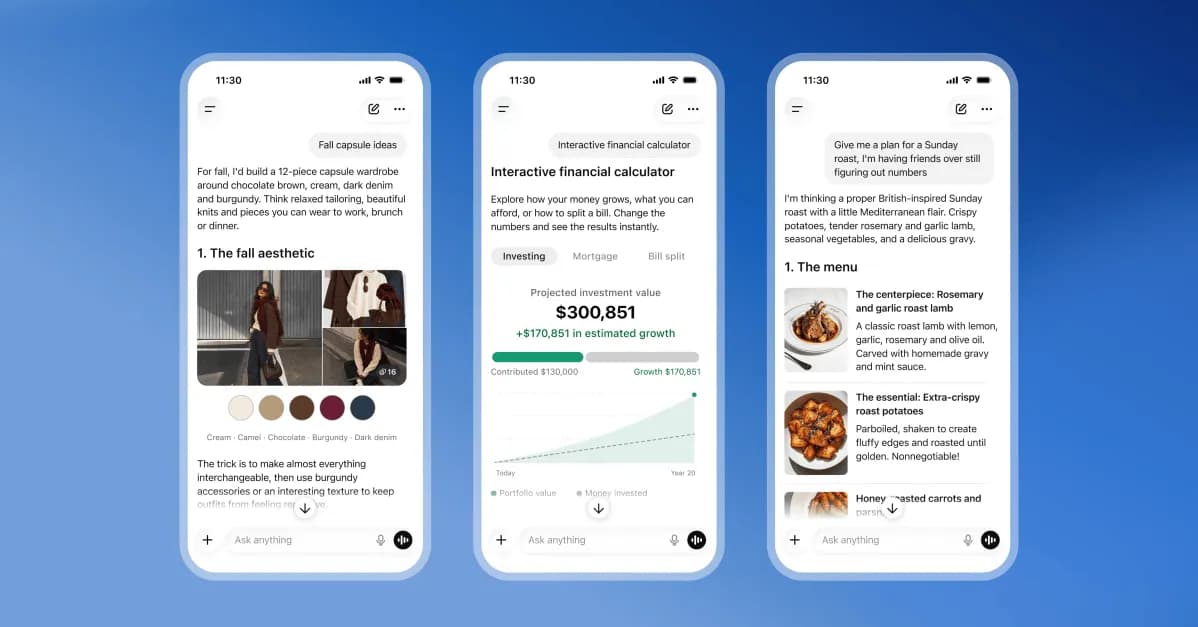
OpenAI is rolling GPT-6 Sol and Luna out to every ChatGPT tier. Answers now come back as charts, forms and mini-apps, not text. That interface shift matters more than the model name.
What happened
Summary of reporting by OpenAI NewsOn 7 October OpenAI began a global rollout of GPT-6 inside ChatGPT, paired with what it calls an Intelligent UI. Responses now render as interactive artefacts: charts, diagrams, forms, tappable buttons, mini-apps. Text is no longer the main output. OpenAI frames this as a new default interaction mode. It says the change reaches all users over the coming weeks. The first phase started on 7 October, and Free and Go users gain access from 8 October. Original reporting: The Verge (https://www.theverge.com/ai-artificial-intelligence/1007276/openai-chatgpt-intelligent-ui-gpt-6) and The Decoder (https://the-decoder.com/chatgpt-with-gpt-6-ditches-mostly-text-output-for-interactive-ui-with-charts-buttons-and-mini-apps/).
Access is split by tier. Plus, Pro, Business and Enterprise get GPT-6 Sol, a version of the family with its own system prompt and behaviour. Free and Go users get GPT-6 Luna. Sol replaces 5.2 as the primary model on paid tiers. OpenAI describes Sol and Luna as one underlying family, instructed to think and act differently. ChatGPT may switch between them under load. One example: a workspace on the org max tier is throttled after three simultaneous Sol answers.
“The model will not always be GPT-6.1 Sol or GPT-6.1 Luna in later conversations.”
OpenAI, to The Verge
The headline technical claim is that the model can respond while it is still thinking. OpenAI says that cuts waiting time by 44% against the previous generation. Community tests reported by The Decoder timed Sol 6K at roughly 2.7 seconds to first response, against roughly 4.7 seconds for the slowest version. The gain comes from interleaved thinking, not from a fundamentally faster model.
This is the second phase of GPT-6 availability. The first GPT-6 models shipped to paid customers in September, announced at DevDay as GPT-6.1 Sol. So this release is the broad-availability and interface step, not just a model refresh. OpenAI has also published technical details and a model card for the served model.
The Azrty take
The real news is not the model. It is that the answer is becoming software, and GCC teams should pin model identity before they automate on a moving target.
The business point is the interface. ChatGPT used to return paragraphs. Now it returns charts, forms and tappable mini-apps. The product stops being a search box with good prose and becomes a lightweight application platform. Take any workflow where an analyst reads a long answer and then rebuilds it in Excel or Power BI. That workflow is now a candidate to collapse into one interactive response. The competitive question stops being which model writes the best answer. It becomes whose workflow turns answers into actions. OpenAI's own framing (https://openai.com/index/introducing-gpt-6-sol-and-luna/) is clearest here. Sol is positioned as fast, conversational and action-oriented, aimed at planning, drafting, analysing and building. For a Dubai team running shared workspaces, the near-term win is internal. Analysis, planning and build tasks that bounce between three tools today can live in one artefact.
Now the caveats that matter to technical decision-makers. Sol and Luna are two behaviours of one family, defined by separate system prompts. Reverse engineers including xravenpx found a meta.json per model setting identity, tone and tool boundaries. Both already show interleaved thinking and program-of-thought behaviour. On hard coding benchmarks, though, Sol is no clean sweep. Community results reported by The Decoder (https://the-decoder.com/chatgpt-with-gpt-6-ditches-mostly-text-output-for-interactive-ui-with-charts-buttons-and-mini-apps/) put GPT-6.1 at 68.7% on SWE-Bench Verified (tracked in the SWE-bench framework: https://github.com/swe-bench/SWE-bench and detailed in its founding benchmark paper: https://arxiv.org/abs/2310.06770). Claude Sonnet 4.5 sits at 77.2%, with DeepSeek-V4 and Gemini 3 Pro in the same conversation. The honest read: Sol wins on latency and interface, about 2.7 seconds to first response against about 4.7, and it is not the obvious pick for autonomous coding. Choosing a coding backend this quarter? Run your own eval set. Do not read a version number as a ranking.
The risk for UAE and GCC organisations is silent model drift. OpenAI itself says the model in a ChatGPT thread will not always be GPT-6.1 Sol or Luna. Workspaces can be throttled mid-task: three concurrent Sol answers on the org max tier can drop to Luna with no warning. If a compliance-sensitive process, a prompt chain or a benchmark depends on a specific model's behaviour, your reproducibility guarantee is already gone at the chat layer. Add that these are consumer-facing terms. The community has already mapped 14 workspace connectors to third-party tools such as Notion and Linear. That leaves a governance gap. Business teams standardise on one chat surface while engineering assumes a fixed model. Most teams will get this wrong by building automations against an implied 'it is GPT-6' contract instead of an explicit model identifier and a logged, pinned version.
How Azrty would approach it: keep ChatGPT for human-facing exploration. Move anything that touches systems onto a controlled path. That means an OpenAI-compatible gateway in front of every model call. Our FastLLM Proxy (/software/fastllm-proxy) fronts your own LLM servers and 80 hosted providers, with routing, budgets and access control in one place. It means explicit model IDs pinned in code, not in a UI. Structured output validated against formal schemas under the JSON Schema standard (https://json-schema.org/specification), not parsed prose. Per-team budgets, so a Sol-shaped cost curve does not surprise finance. Application code sits behind a multi-provider SDK. Our open-source go-ai-sdk (/software/go-ai-sdk) covers 40 providers with text, streaming, structured output, tools, embeddings, images and speech, so swapping Sol for a rival is a config change, not a rewrite. The pattern we would start with:
curl -sS "$GATEWAY/v1/chat/completions" \
  -H "Authorization: Bearer $GATEWAY_KEY" \
  -H "Content-Type: application/json" \
  -d '{
    "model": "GPT-6-Sol-6k",
    "messages": [
      {"role": "system", "content": "Return a chart spec as JSON, not prose."},
      {"role": "user", "content": "Q3 revenue by emirate from the attached CSV"}
    ],
    "response_format": {"type": "json_schema", "json_schema": {
      "name": "chart_spec", "strict": true,
      "schema": {"type": "object",
        "properties": {"chart_type": {"type": "string"}, "data": {"type": "array"}},
        "required": ["chart_type", "data"], "additionalProperties": false}}}
  }'
The gateway logs the model actually served, so a Sol-to-Luna swap is visible instead of silent. The opportunity is real. OpenAI's own testing against the previous generation shows a 44% cut in wait time, and OpenAI explicitly warns results vary. Interactive output makes chat-based internal tools viable in a way they were not six months ago. The trap is treating this as a drop-in upgrade. Pin the model. Log what actually served the request. Let the interface novelty follow the architecture rather than drive it.
What to do now
- Run a two-week bake-off on 20 to 30 of your own real tickets: GPT-6 Sol against Claude Sonnet 4.5 (reported 68.7% versus 77.2% on SWE-Bench Verified) and Gemini 3 Pro. Score correctness, first-response latency and cost per task. Do not pick a coding backend from the version number.
- Put an OpenAI-compatible gateway such as FastLLM Proxy in front of every model call this month. Pin explicit model IDs in code, set per-team budgets and rate limits, and log the model name actually served, since ChatGPT can switch Sol to Luna under load without warning.
- Update your shared prompt library (PromptForge is built for this) so prompts request structured artefacts: JSON chart specs, form schemas and tappable actions instead of prose someone reformats. Version the prompts and retire the text-only ones.
- Admins on Plus, Business or Enterprise: track the phased rollout (Sol to paid tiers from 7 October, Luna to Free and Go from 8 October, full coverage over the coming weeks) and pilot Intelligent UI in one internal workflow first. Review which of the 14 workspace connectors are enabled before teams attach sensitive Notion, Linear or calendar data to mini-apps.