Microsoft and Nvidia launch RTX Spark Windows PCs and let Copilot act on local files
Pre-orders opened on 7 October for two Surface machines built on Nvidia's RTX Spark superchip. The same event pushed local models into GitHub Copilot and gave Windows OS-level control over what an agent may read and touch. For enterprise buyers the real story is that control plane, Microsoft Execution Containers. Microsoft's own repository describes it far more cautiously than the GA language does.
What happened
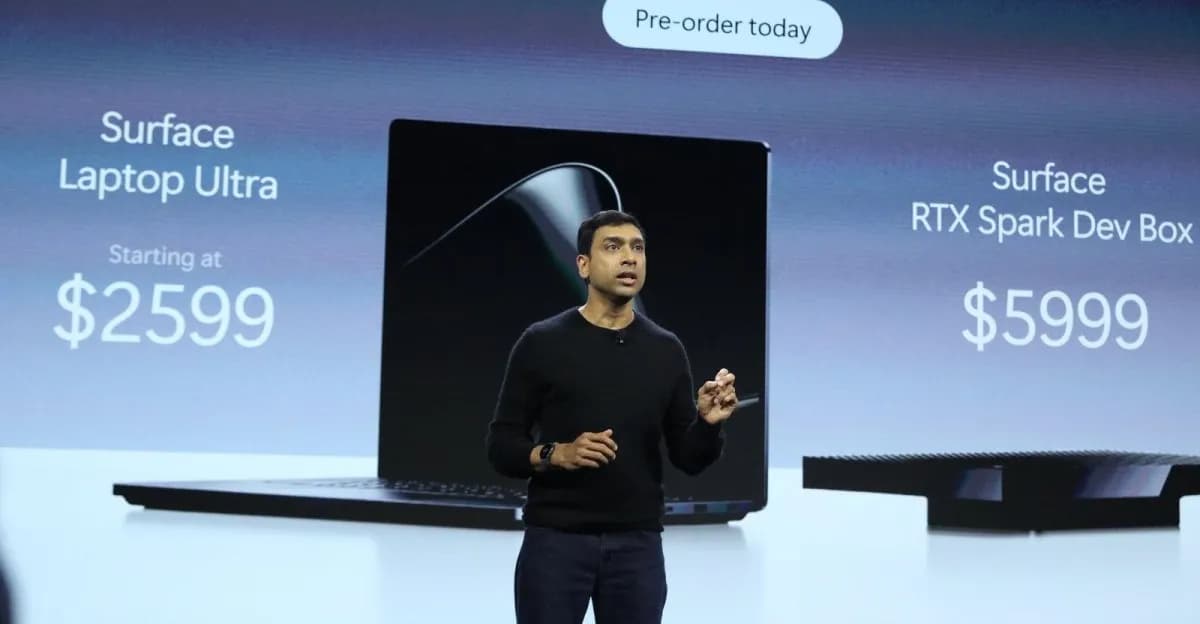
Summary of reporting by The VergeAt a San Francisco event on 7 October, Microsoft and Nvidia turned their joint Windows push into shipping hardware. Pre-orders opened for the Surface Laptop Ultra, from $2,599. That is the entry configuration: 8 CPU cores, 24GB RAM, 512GB storage, available from 16 October. The Surface RTX Spark Dev Box costs $5,999 and ships in the United States in November. Both are built around Nvidia's RTX Spark superchip: a Blackwell RTX GPU with up to 6,144 cores, a Grace CPU with up to 20 cores, up to 128GB of unified memory and a claimed petaflop of FP4 AI compute. That is enough to load models beyond 120B parameters. Asus, Dell, HP, Lenovo and MSI have RTX Spark laptops of their own shipping from 16 October.
The software story is what Microsoft calls hybrid intelligence. On Copilot+ PCs, Copilot gains three local capabilities. Context drawn from files and recent activity, with permission. Actions across Windows, such as organising files or running device diagnostics. On-device models used alongside cloud ones. GitHub's HydraFusion orchestrator is being extended to route tasks to local models, with an experimental preview in the GitHub Copilot app, Copilot CLI and Visual Studio Code later in October. The local line-up includes a quantised build of Microsoft's MAI Code 1.1 Flash (137B total, 6.8B active parameters) at about 3.3 bits per weight with a 256K context, an Nvidia Nemotron model above 70B parameters at 2-bit precision using just over 20GB of memory, and DeepSeek V4 Flash at 284B parameters.
Underneath sits Microsoft Execution Containers (MXC), described as generally available on Windows 11. Developers declare which files and network destinations an agent may use. The operating system enforces those limits at runtime. GitHub Copilot, OpenAI Codex, Replit, LM Studio and Nvidia's OpenShell already integrate, with Claude Code, Perplexity and others announced to follow. Microsoft also flagged llama.cpp support in its Windows ML runtime. Machines on Nvidia's DGX Station for Windows, with up to 748GB of coherent memory, arrive later this year.
Sources: The Verge (https://www.theverge.com/tech/1007147/microsoft-surface-laptop-ultra-windows-event-everything-announced), CNBC (https://www.cnbc.com/2026/10/07/microsoft-starts-taking-preorders-for-2599-surface-laptop-ultra.html), Ars Technica (https://arstechnica.com/gadgets/2026/10/microsoft-event-debuts-new-ai-friendly-hardware-and-windows-changes/), NVIDIA blog (https://blogs.nvidia.com/blog/local-ai-rtx-spark-microsoft-windows-event/).
The Azrty take
The silicon is real. For GCC buyers the thing to procure is the agent control plane, and it is not finished yet.
For CTOs and heads of engineering in the UAE and GCC, the question this week is not whether local AI got faster. It did. The question is whether Windows endpoints just became a governed place to run agents, because that is what Microsoft is actually selling. Hybrid intelligence moves inference to wherever the task pays for it. It also puts the operating system in charge of what an agent may touch. That hits three budgets at once: cloud token spend, data residency and endpoint security policy. The $2,599 entry Surface Laptop Ultra is a fine laptop. The configuration that matters for agent work is the 20-core RTX Spark unit with up to 128GB of unified memory, or the $5,999 Surface RTX Spark Dev Box (https://blogs.windows.com/devices/2026/10/07/pre-order-our-most-powerful-surface-devices-ever/) shipping in November.
What runs on the desk now is concrete. Microsoft's on-device build of MAI Code 1.1 Flash (137B total, 6.8B active parameters) is quantised to roughly 3.3 bits per weight. It occupies 53GB, about 80% smaller than the bfloat16 cloud version, and holds a 256K context. Microsoft measured prompt processing at 923.5 tokens per second at 64K context and peak memory of 75.5GB at 256K. Quality stays close to the cloud model: 70.8% on SWE-Bench Verified (https://github.com/swe-bench/SWE-bench) against 72.6%, and 66.29% on Terminal-Bench 2.1 against 62.9%. Unsloth's GPT-OSS-120B GGUF scored 32.0% and 23.6%. Against a MacBook Pro 16-inch M5 Pro, Microsoft claims 2.1x faster time to first token in llama.cpp (https://github.com/ggml-org/llama.cpp) on Qwen3.5 27B. At the top end sits DGX Station for Windows (https://blogs.windows.com/windowsexperience/2026/10/07/building-windows-for-hybrid-intelligence/) on the GB300 Grace Blackwell Ultra Desktop Superchip: up to 748GB coherent memory, 20 petaflops FP4. Microsoft pitches it as a deskside token factory for 32 or more concurrent agents, from Dell and HP later this year. That is the credible on-prem answer for workloads that cannot leave your environment.
The risk sits in the control plane. Copilot's new local actions and local file context mean an agent reads what is on the disk. Microsoft Execution Containers is the boundary meant to contain it. Read the MXC repository (https://github.com/microsoft/mxc) before you accept the GA language. Its README states plainly that today's profiles do not yet function as security boundaries, and that filesystem deny paths are not supported on Windows. In GitHub Copilot's integration (https://commandline.microsoft.com/local-models-sandboxed-tools-github-windows/), the built-in file tools are checked in-process rather than by OS-enforced child-process isolation. Agent identity through Microsoft Entra and Intune management of MXC containers are both still coming. Most teams will get this wrong twice: treating MXC as a finished data-loss control, and buying the 24GB entry SKU while planning 120B-class local models.
How we would approach it: separate inference placement from policy. Put a gateway such as our FastLLM Proxy (/software/fastllm-proxy) in front of your own model servers and hosted providers. Routing, budgets and access control then live in one place, while an orchestrator such as HydraFusion picks local or cloud per task. On endpoints, run every agent tool call inside MXC-style containment. Start in Permissive or Learning mode, collect the JSON activity report, then switch to Enforcement. The starting policy for a repo-scoped coding agent looks like this:
{
  "version": "0.6.0-alpha",
  "process": {
    "commandLine": "npm test",
    "workingDirectory": "C:\\work\\app",
    "timeoutMs": 600000
  },
  "filesystem": {
    "readonlyPaths": ["C:\\work\\app", "C:\\tools\\node"],
    "readwritePaths": ["C:\\work\\app\\.mxctmp"]
  },
  "network": { "allowOutbound": false }
}
The GCC opportunity is specific. Token bills are real. Residency rules are non-negotiable for many workloads. A 128GB unified-memory device or a DGX Station-class box can hold DeepSeek V4 Flash at 284B, or a Nemotron above 70B at 2-bit in just over 20GB, with no network round trip. The wrong turn is treating this as a laptop refresh. Treat it as an agent estate: identity per agent, containment per workload, budget per token. Same gateway on a Surface Laptop Ultra and on a server in your own rack. That is the shape our AI infrastructure (/services/operate) and AI engineering (/services/build) work takes. It is the standard we would hold any agent rollout to before a single prompt touches local files.
What to do now
- For local agent work, order the 20-core RTX Spark configuration with up to 128GB unified memory, not the $2,599 8-core/24GB entry unit. That means the Surface Laptop Ultra, or the $5,999 Surface RTX Spark Dev Box when it ships in November. Microsoft's own MAI Code 1.1 Flash numbers need 75.5GB of peak memory at 256K context.
- Clone github.com/microsoft/mxc, install @microsoft/mxc-sdk (schema 0.6.0-alpha), and run each agent workload with wxc-exec.exe --audit policy.json in Permissive or Learning mode for two weeks before flipping to Enforcement. On Windows, express exclusions as allow-lists only: deny paths are not supported.
- In the GitHub Copilot CLI run /sandbox and enable Sandbox new sessions per project now. When HydraFusion local routing lands in experimental preview later in October, pin MAI Code 1.1 Flash through the Windows ML provider. Verify that shell commands, local MCP servers and language servers still execute inside the MXC boundary.
- Put one gateway such as FastLLM Proxy in front of local runtimes and hosted providers, so routing, budgets and access control are set in one place. Evaluate DGX Station for Windows as an on-prem option for 32 or more concurrent agents.