UAE and US advance $1.4tn technology framework after A:5 chip-access upgrade
Three days of Washington talks on AI, cybersecurity, space and quantum follow the UAE's A:5 reclassification. Approved UAE entities now get licence-free access to US AI chips and servers.
What happened
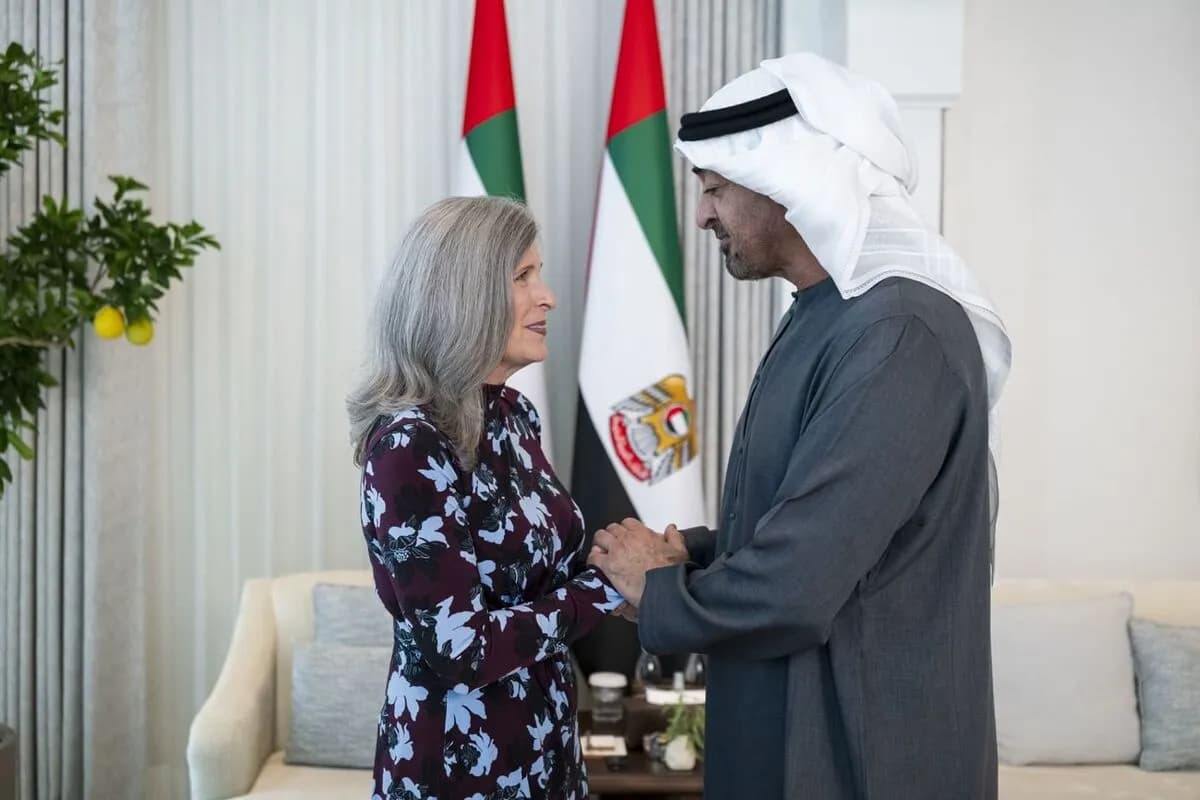
Summary of reporting by Arabian BusinessUAE President Sheikh Mohamed bin Zayed Al Nahyan received US Senator Joni Ernst of Iowa on Friday 2 October. The agenda: strategic cooperation and regional security. The Emirates News Agency called them bilateral discussions. No new agreements were announced. Ernst sits on the Senate Armed Services Committee. She chairs the Emerging Threats and Capabilities Subcommittee, the panel covering emerging military tech.
In parallel, a UAE delegation went to Washington. Omran Sharaf, Assistant Foreign Minister for Advanced Science and Technology Affairs, led it. Over three days the team met the State Department, the Department of Commerce, the White House Office of Science and Technology Policy, IonQ, ITI, SIIA and several think tanks. Arabian Business reports the agenda covered AI, cybersecurity, space, quantum computing and export policy. The talks were tracked against the $1.4 trillion UAE-US technology investment framework agreed in March 2025 (Reuters).
“The part a CTO should read twice is export control.”
Azrty take
The delegation included Dr Mohamed Al Kuwaiti, Head of Cyber Security for the UAE Government. Representatives from the Advanced Technology Research Council, the UAE Space Agency and Space42 were also there. Sharaf framed the visit as implementation. The partnership rests on five decades of defence, intelligence and nuclear cooperation. It now extends to AI and advanced technology.
The talks build on moves that already changed the ground for UAE enterprises. The May 2025 US-UAE AI Acceleration Partnership includes a 1GW AI data centre. That is the first phase of a planned 5GW campus in Abu Dhabi. The 10 July 2026 Commerce decision reclassified the UAE into export-control Country Group A:5. It is the first Arab state to receive that tier. Approved UAE entities and the UAE Government now get licence-free access to advanced computing items, including AI chips and servers. Bilateral trade reached $39 billion in 2025, per UAE officials.
The Azrty take
The A:5 upgrade makes chips an entitlement for approved UAE entities. For everyone else it is a compliance problem. AI platforms here need entity-aware routing, version pinning and audit from day one.
Strip out the ceremony and this month's Washington meetings have one purpose for enterprises: keep the $1.4 trillion framework turning. The part a CTO should read twice is export control. On 10 July 2026 the Commerce Department removed the UAE from Country Groups D:3 and D:4. It reclassified the UAE as A:5, the tier occupied by Australia, Canada, New Zealand and the UK. The BIS announcement pairs that with Strategic Trade Authorization eligibility for UAE government and approved commercial entities. It also grants licence-free access to advanced computing items, including AI chips and servers.
The Federal Register final rule (91 FR 43034, published 14 July 2026) is the document to bookmark. The fast lane is entity-specific, not country-wide. Supplement no. 8 to part 740 lists the approved recipients. UAE government agencies are on the list. So are two UAE-based AI companies: Group 42 Holding (including G42 Cloud Technology) and Core42. US-headquartered AI companies such as Amazon.com and Apple, and their subsidiaries, are also listed. There is a condition. G42 and Core42 must become US companies on or before 6 April 2027. If they miss that date, they reapply through the advisory-opinion process to keep their status. Everyone else in the UAE still faces the worldwide licence requirement. That is 742.6(a)(6)(iii)(A) of the EAR, covering ECCNs 3A090.a, 4A090.a and related .z items. Procurement is now an entity question before it is a price question.
The compute behind the designation is contracted. The May 2025 AI Acceleration Partnership includes a 1GW AI data centre. That is the first phase of a planned 5GW campus in Abu Dhabi, spanning some 10 square miles. It is the largest such deployment outside the US. A G42-led consortium is building it. When complete, the campus can serve nearly half the world's population within 3,200 km. Power comes from nuclear, solar and gas. The White House fact sheet records the offsetting commitments. The UAE invests in US data centres at least as large and powerful as its own. It also commits over $200 billion in new deals. One stands out: an AWS, e& and UAE Cybersecurity Council Sovereign Cloud Launchpad expected to contribute $181 billion to the UAE digital economy by 2033. Capacity comes with guardrails. Deployments run on letters of assurance covering training data location, model ownership, security measures and deployment location. Material changes are reportable to BIS within 24 hours. Model weight commitments cap UAE-trained models at least 15 percent below the US frontier through 2027. By 2028 the gap must be at least 50 percent. The practical result is a split market: US-hosted frontier APIs, in-country capacity under guardrails, and your own fleet.
This is why we build AI platforms gateway-first. The approach we would apply: one OpenAI-compatible gateway, our FastLLM Proxy, in front of your own LLM servers and 80 hosted providers. Routing, budgets and access control live in one place. Backends selected by data class rather than habit. Agents that need isolation run on your own GPU estate through Kuvryn AI, each in its own space. Prompts versioned in PromptForge so a model swap is a reviewable change. Dhole holds an approval gate where work crosses a jurisdiction boundary. An illustrative routing policy:
routes:
  - name: general-work
    match: { data_class: public }
    providers: [us-hosted-frontier]        # OpenAI, Anthropic, Azure OpenAI US regions
  - name: uae-regulated
    match: { data_class: [regulated, uae-resident, pii] }
    providers: [g42-cloud-abu-dhabi]       # approved-entity, in-country
  - name: sovereign
    match: { data_class: sovereign }
    providers: [self-hosted-gpu-fleet]     # your own infrastructure
policies:
  pin_model_versions: true                 # audits ask which weights served which request
  log: [model, version, region, tenant, data_class]
  fallback: reject                         # never silently re-route regulated work
budgets:
  per_tenant_monthly_usd: 25000
Where most teams will get this wrong: assuming A:5 is a country-wide green light. It is entity-specific and the list is short. The likely failure mode for 2026 and 2027: a signed GPU or cloud contract with a counterparty outside supplement no. 8 to part 740. Then a licence application nobody budgeted time for. The second: discovering audit records and 24-hour reporting duties after the architecture is frozen. The opportunity is equally concrete. In-country frontier-class compute with legal certainty on chips did not exist here two years ago. The UAE is now the lowest-friction place in the region to contract it. The winners will be the platforms that can prove, per request, which model served, which version, in which country, under whose authorisation.
What to do now
- Classify every AI workload by data class and jurisdiction. Then route all inference through one OpenAI-compatible gateway (our FastLLM Proxy fits this). Set a routing rule per class and log model, version, region, tenant and data class per request.
- Before signing any GPU, server or cloud contract this quarter, check the counterparty against supplement no. 8 to part 740 (Federal Register 2026-14132). Licence-free advanced computing items flow only to UAE government agencies, G42, G42 Cloud Technology, Core42, and listed US-headquartered AI companies and their subsidiaries.
- If your 2027 capacity plan depends on G42 Cloud or Core42, model the 6 April 2027 US-company deadline now. Build a fallback backend so a status change cannot strand workloads.
- For regulated workloads, pin model versions and keep prompts versioned (PromptForge-style). You need to evidence which weights served which request when an audit under the letters-of-assurance regime arrives.