
NovaGrade
AI vision grading platformWritten exam answers marked against your own guide. Teachers review the marks instead of starting from a blank script.
AI marking of open-ended exam answers, criterion by criterion. It is built into Kodak scanning, so teachers review instead of mark.
For schools and exam boards
Written answers still eat hours
Scanners have marked multiple-choice papers for decades. Open-ended answers still go to teachers one at a time. Marking an essay or a worked calculation against a guide is slow, repetitive work, and it arrives at the busiest point of the school year. A general AI chatbot won’t do either: the marks have to follow the official guide, and the scripts shouldn’t leave the school.
Why it’s built the way it is.
Marks the way your guide says
The marking guide has the final word. NovaGrade awards marks one criterion at a time, gives partial credit, and follows whatever marking policy the guide lays down.
Designed not to misgrade
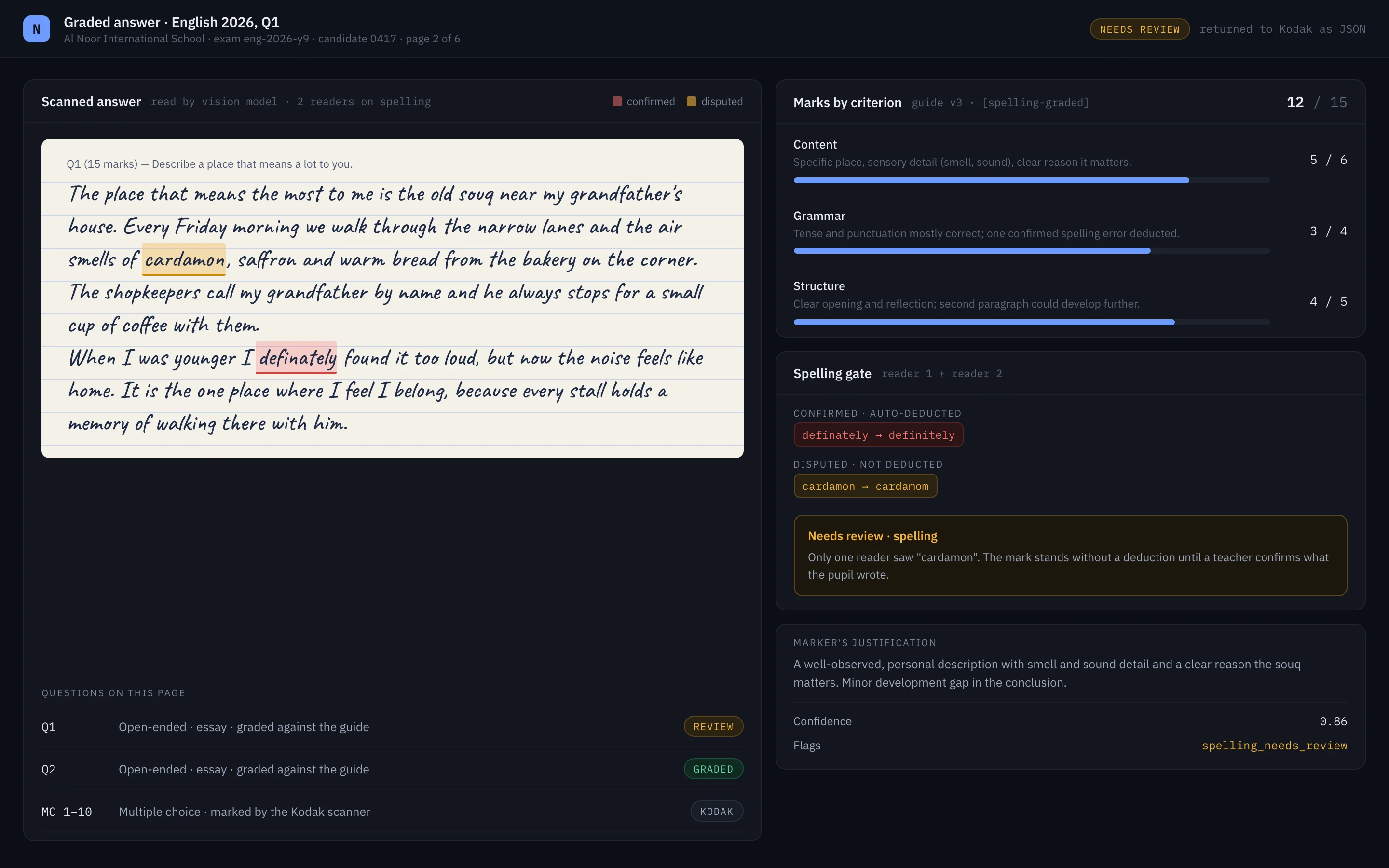
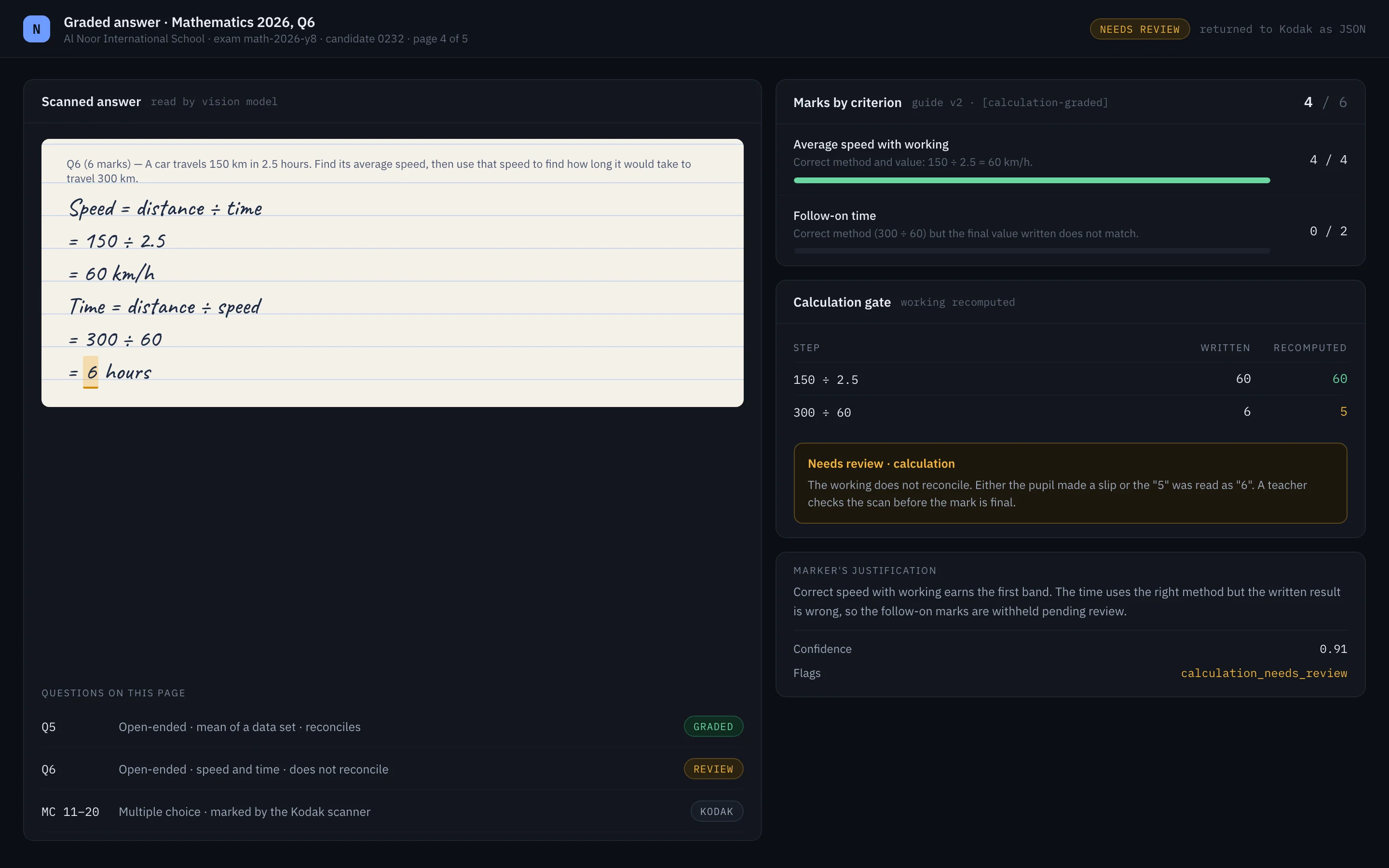
A spelling error costs marks only when two independent readers agree on it. Calculations are worked out again. If something is disputed or doesn’t add up, a teacher sees it. Nothing is guessed.
Fits the Kodak scanners you already have
Kodak carries on marking the multiple-choice questions. NovaGrade takes the open-ended ones, as text or as a scanned page, and hands structured marks back into the same workflow.
Exam papers stay on site
The grading service runs at the school or exam board, and the AI models can run on your own GPU. For licensing, only anonymous usage counts go out.
From setup to everyday use.
- 1
Upload the marking guide
Each exam gets a plain markdown guide: questions, criteria and mark allocations. Optional markers flag questions graded on spelling or calculation.
- 2
Kodak sends the answers
The scanning software sends each open-ended answer as text. Or it sends the whole scanned page, and NovaGrade finds the questions and reads the handwriting itself.
- 3
Every criterion gets a mark
An AI marker scores each criterion in the guide. It adds a short justification and a confidence score.
- 4
Safeguards check the sensitive parts
Spelling and calculation checks run wherever the guide asks for them. Disputed spellings, working that doesn’t reconcile and low-confidence marks are all flagged for review.
- 5
Teachers review, they don’t re-mark
Marks come back as structured JSON, with the breakdown and the flags. Staff only look hard at what was flagged.
See NovaGrade at work.
What it does, in detail.
Marking
- Partial credit per criterion Marks follow the criteria in the guide. It’s not a simple right or wrong.
- Policy from the guide How strict to be, and when partial credit applies, comes from the policy written in the guide.
- Justification and confidence Each mark carries a reason of a sentence or two, and a confidence score.
- Blank answers and missing guides A blank answer scores zero with no model call. An answer with no guide is flagged, never marked blind.
Scanned pages
- Whole-page input Send in a scanned page. A vision model finds the open-ended questions and reads the handwriting.
- Raw transcript returned What the model read comes back alongside the marks, so anyone can audit it.
- Spelling consensus A second, independent reader checks the spelling. Only errors both of them agree on lose marks.
- Calculation check The pupil’s working is recomputed. If it doesn’t match, a teacher gets it.
Integration
- Grading API Single, batch and page endpoints. Each returns structured JSON with the breakdown per criterion and any flags.
- OpenAI-compatible endpoint If your software already talks to an OpenAI-style chat API, it can call NovaGrade in the same way.
- Versioned guides Guides are stored per exam through the API. Every result records which guide version marked it.
- Integration replay tool A simulator replays a fixture exam against the service just as Kodak would. Test it well before exam season.
Licensing and operations
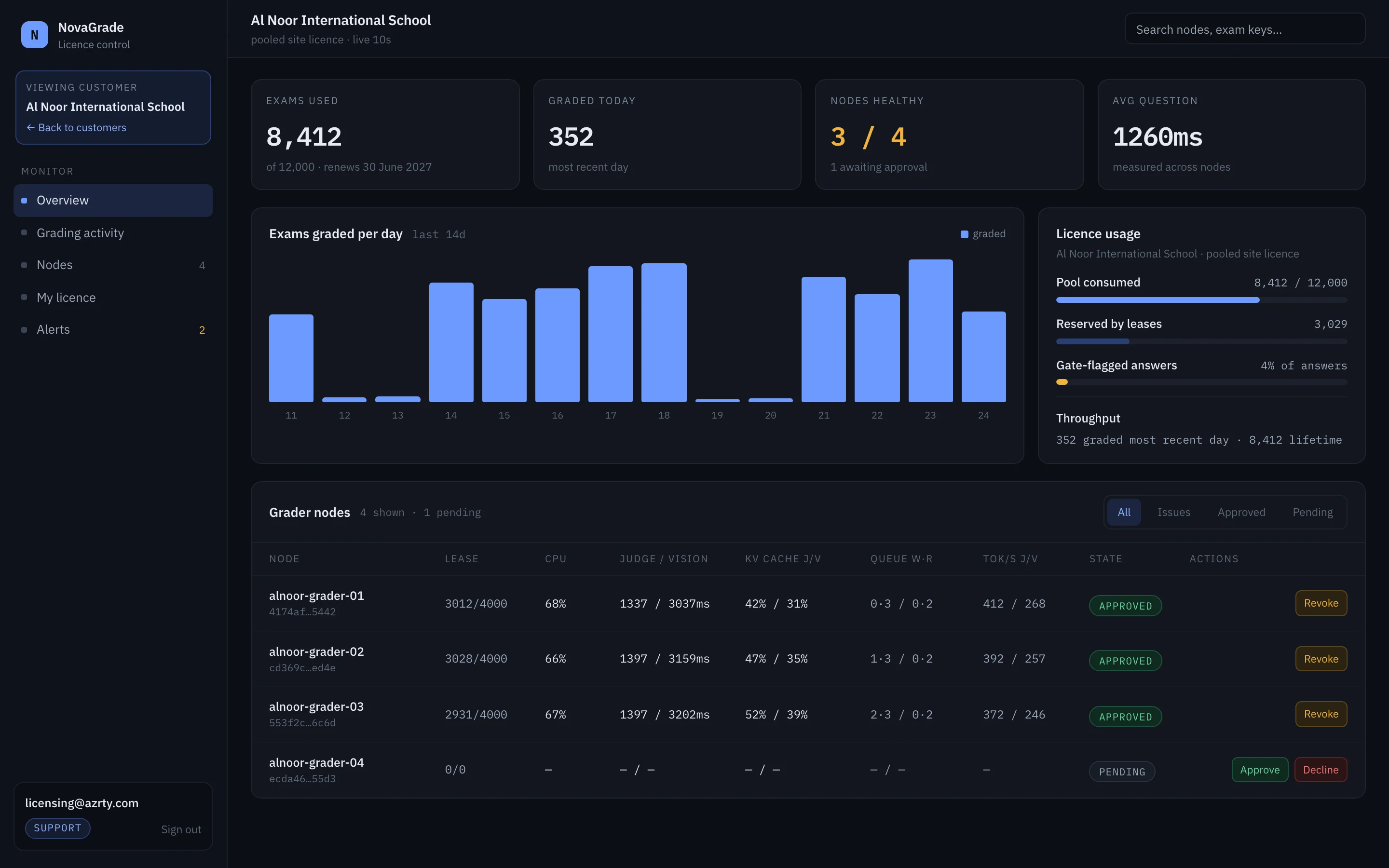
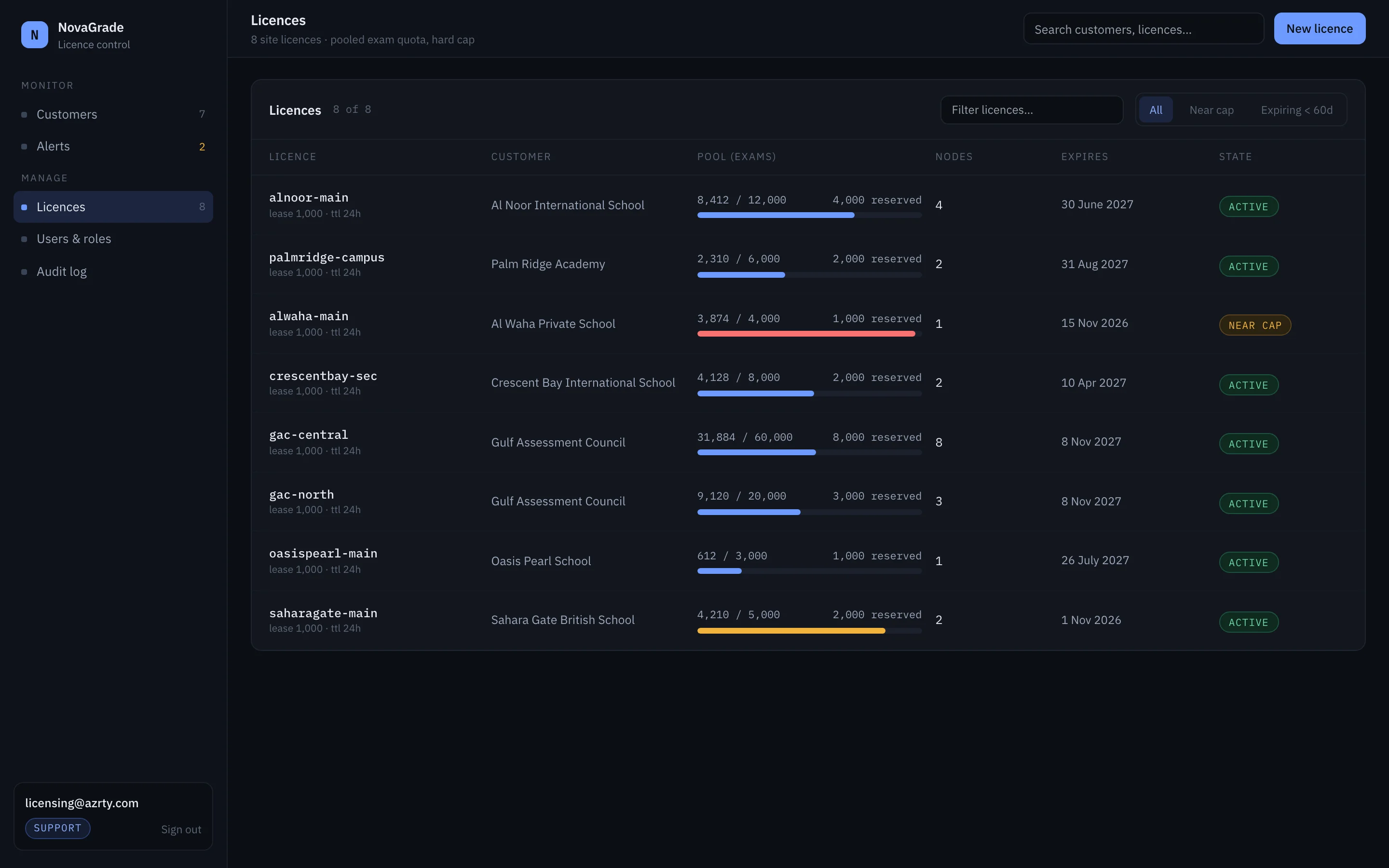
- Usage-based licence Signed licences meter each distinct exam. Re-grade the same paper and it still counts once.
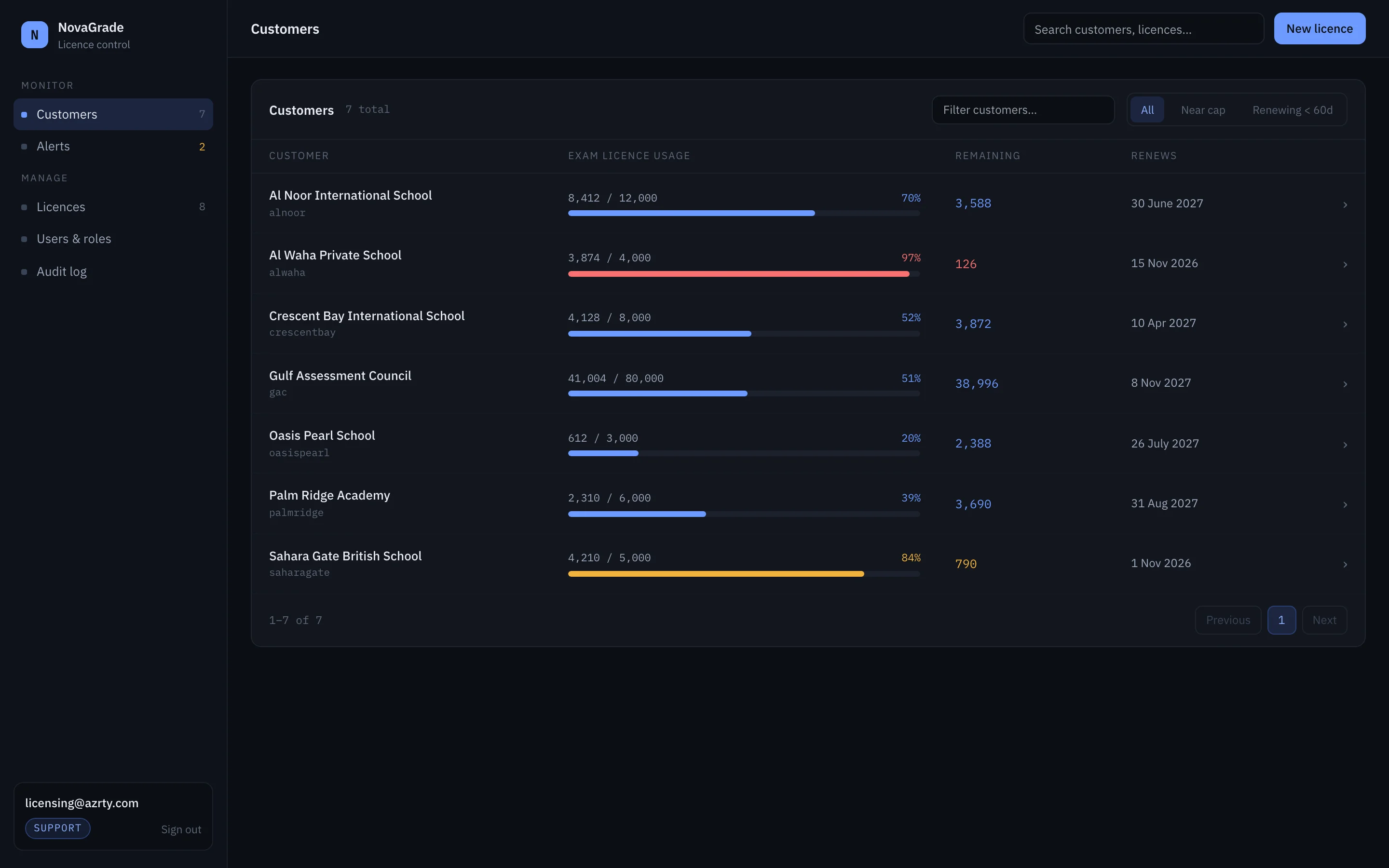
- Pooled across servers Several grading servers can share a single site licence. A new server gets no capacity until someone approves it.
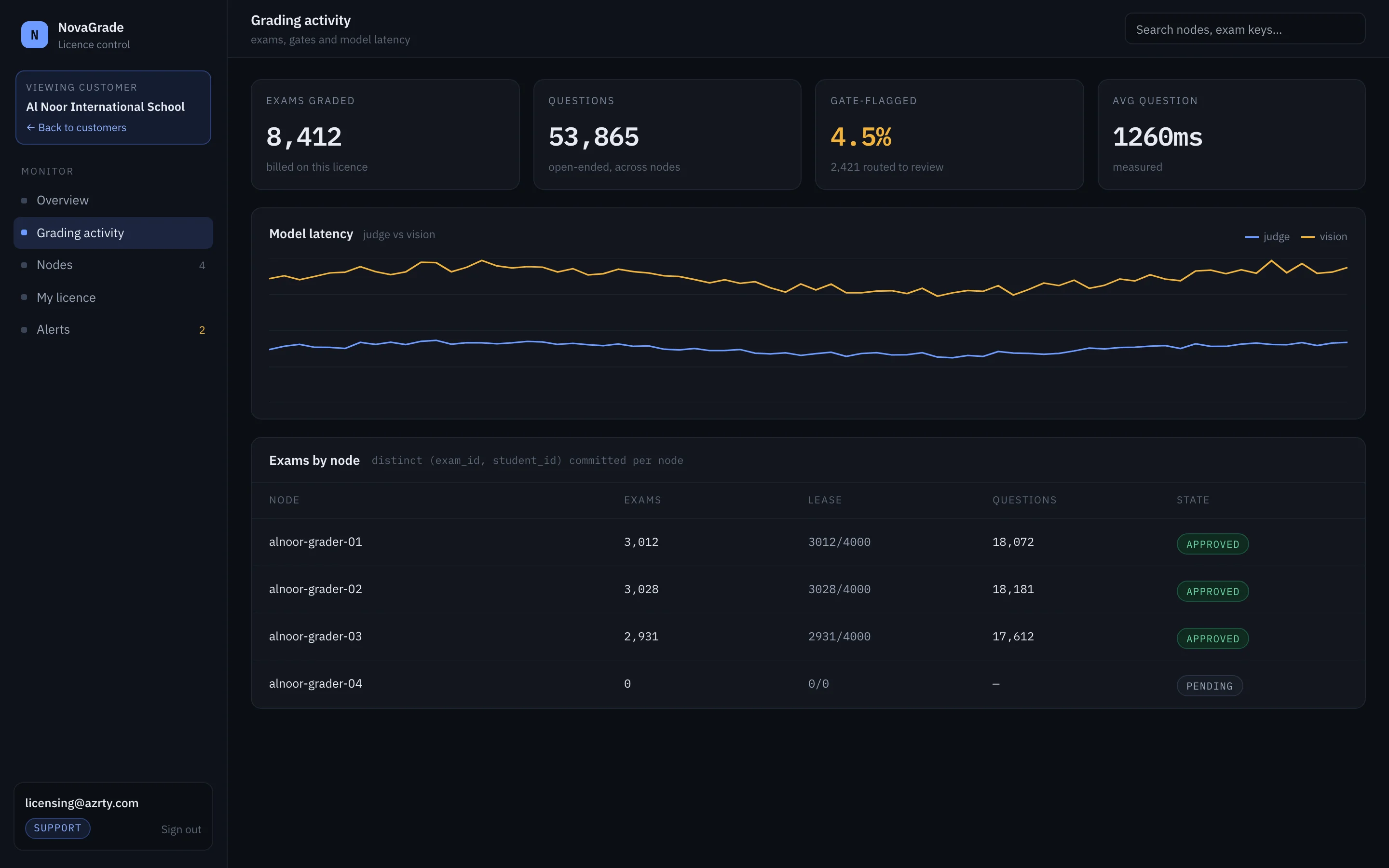
- Keeps working offline for a while Servers grade against a signed lease and sync usage from time to time. A short network outage won’t stop marking.
- Admin console One web console for usage, grading activity, model latency and server health, with an audit log.
Who uses it, and for what.
School end-of-term exams
A school with Kodak scanners marks English essays and maths working overnight. Teachers spend their time on the answers that got flagged.
Exam boards at scale
An exam board runs several grading servers on one pooled licence. Large volumes of written answers are marked to one consistent guide.
Mocks and practice papers
Departments turn practice papers round quickly, and pupils get feedback on each criterion while the topic is still fresh.
At a glance
- Runs on
- Linux server at your site (Docker or systemd); AI models on your GPU or a hosted endpoint
- Deployment
- Grading service on your premises; licence server hosted by Azrty
- Integrates with
- Kodak scanning software; any system that can call a REST or OpenAI-compatible API
- AI models
- Any OpenAI-compatible text and vision models (Qwen, for example); optional second spelling reader
- Input
- Answer text, or a scanned page image with handwriting
- Built with
- Go (compiled binary), React admin console
Questions
Do exam papers leave our premises?
No. The grading service runs at your site and can use AI models on your own GPU. The licence server receives anonymous, hashed counts of exams graded. It never sees pupils’ names or answers.
Does it replace teachers?
No. It marks against your guide and shows how it arrived at each mark. Anything uncertain, disputed or not adding up goes to a teacher, and teachers set the final mark.
Do we need Kodak scanners?
NovaGrade is designed to sit behind Kodak’s scanning software, which handles the multiple-choice questions. Other systems can call the same API with answer text or scanned pages.
What does it need to run?
A Linux server for the grading service, plus a text model and a vision model, on your own GPU or a hosted endpoint. We help you size it during setup.
How is it priced?
The licence is usage-based, per exam graded, with one pooled quota across all your grading servers. The price depends on volume and deployment. Book a demo and we’ll talk it through.
AI that solves one job, properly.
Nexora
Enterprises and telecom operatorsA DNS platform for enterprises and telecom operators. Resolving and filtering, plus authoritative DNS, run from one console across a fleet of servers.
Learn moreEnterprise AI prompt libraryPromptForge
EnterprisesA shared library for AI prompts. Teams keep the prompts that work, version them and pass them on, so nobody starts from scratch.
Learn moreSee it on your own data.
We run the demo with your data, then propose a scope and pricing.