Lootah Robotics opens UAE's first humanoid showroom as Dubai targets 200,000 robots by 2032
28 machines on Sheikh Zayed Road, purchase prices from Dh50,000 to Dh3 million and rentals from under Dh5,000. Robotics is now a procurement category in the UAE, and the operating layer decides whether a fleet pays off.
What happened
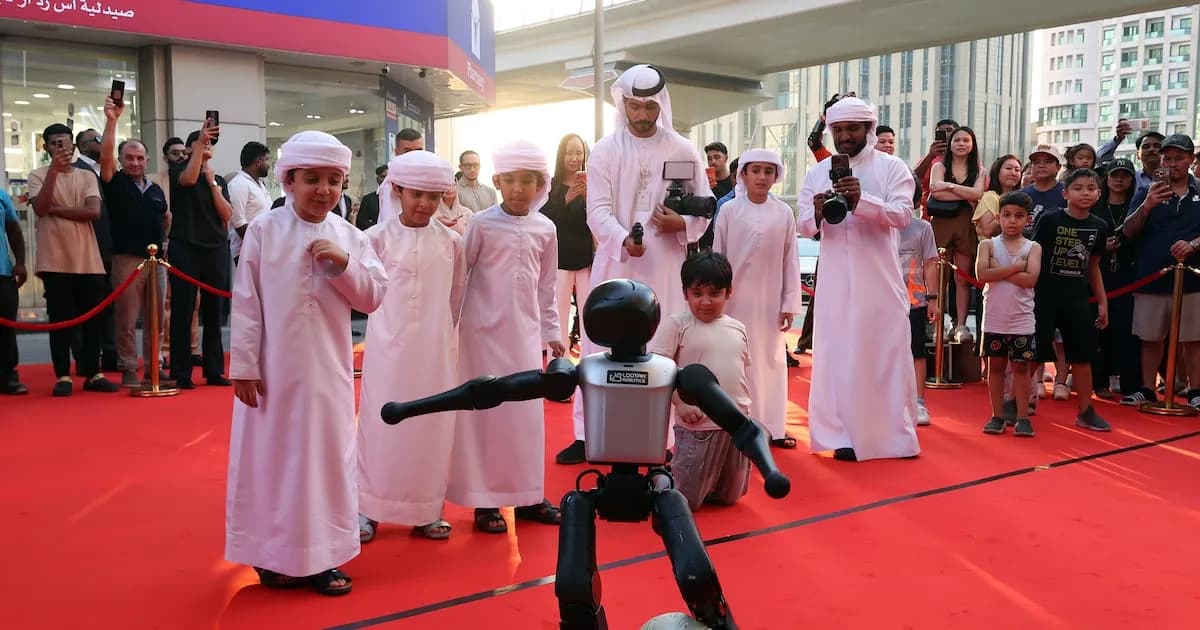
Summary of reporting by The NationalLootah Robotics opened what it describes as the UAE's first dedicated humanoid robotics showroom on Sheikh Zayed Road in Dubai on 6 November. Around 28 machines were on the floor, and more than 4,000 people watched the opening online. Purchase prices run from Dh50,000 to Dh3 million and rentals start below Dh5,000, though the reporting does not specify the rental period or which models carry which price.
Founder Yousif Al Lootah tied the launch to the Dubai Robotics and Automation Programme, which Sheikh Hamdan bin Mohammed introduced in 2022. That programme targets 200,000 robots across the emirate by 2032 and a robotics contribution of 9 per cent to Dubai's GDP before that year.
The market underneath it is growing fast from a small base. IDC counted about 25,000 humanoid shipments worldwide in the first half of 2026, up 432 per cent year on year, on more than $740 million of revenue, and forecasts the global market at $6.24 billion in 2026 rising to $165 billion by 2034. Horizon Databook, cited by The National, projects the UAE humanoid market at $7.4 million in 2025 and $156.8 million by 2033, a CAGR above 40 per cent. At AI Everything 2026, Faisal Al Bannai, adviser to the UAE President and secretary general of the ATRC, said he expects the UAE to become the largest deployer of autonomous vehicles and advanced robotics outside China within a year.
The Azrty take
Robots are now a budget line in the UAE, and the operating layer decides whether the fleet pays off
For CTOs and operations leads in the UAE, the important number from this opening is not 28. It is Dh50,000, the entry purchase price, and under Dh5,000 for a rental. That sits inside most departmental opex limits, so a pilot can be approved this quarter without a capital committee, and the decision shifts from whether to try a robot to how to measure one. Start with a task you can score: floor cleaning on a defined shift, or a fixed inspection round on a construction or energy site. (The National: https://www.thenationalnews.com/news/uae/2026/11/06/uae-opens-its-first-humanoid-robotics-showroom-as-dubai-races-to-200000-robots/ and Nakoda News: https://news.nakoda.ai/article/lootah-robotics-uae-first-humanoid-robot-showroom-dubai)
The target behind it is written down, not just quoted at a launch. The Dubai Robotics and Automation Program, as the official UAE government page sets it out, commits to 200,000 robots over the ten years to 2032 and to lifting the robotics sector's contribution to Dubai's GDP to 9 per cent before that year. It lists five strategic initiatives, among them a council for robotics and automation, an act for the use of robots and an enterprise adoption programme (https://u.ae/en/about-the-uae/strategies-initiatives-and-awards/strategies-plans-and-visions/industry-science-and-technology/dubai-robotics-and-automation-program). That 200,000 implies roughly 20,000 units a year for the emirate, our arithmetic on the stated target. Twenty-eight machines in a showroom is a rounding error against it, and the number will be met mostly by service, cleaning, inspection and logistics units rather than bipeds. Our read: a UAE robotics strategy that starts with humanoids is starting with the hardest use case and the least mature supply chain. The act for the use of robots and the adoption programme are the parts that will shape your procurement, your insurance and your permits. The target is not a forecast of humanoid density on your site.
Keep the market size in view before you write a three-year plan. IDC counted about 25,000 humanoid shipments worldwide in the first half of 2026, up 432 per cent year on year, on more than $740 million of revenue, which averages out under $30,000 a unit across the range. It forecasts the global market at $6.24 billion in 2026 and $165 billion by 2034. Horizon Databook, cited by The National, puts the UAE humanoid market at $7.4 million in 2025 rising to $156.8 million by 2033, a CAGR above 40 per cent from a very small base. Treat the political ambition as policy intent: useful for anticipating government-adjacent demand, insufficient on its own to justify a fleet.
Technically, we would treat every robot as an edge node in an AI platform, not as an appliance. Telemetry, logs and task outcomes stream into your own infrastructure, so the 90-day decision rests on your data rather than a vendor dashboard. Perception and planning models sit behind one OpenAI-compatible gateway, so inference can move between your own GPU servers and hosted providers with routing, budgets and access control in one place, which is what our FastLLM Proxy does (/software/fastllm-proxy). Agents and models run in isolated spaces on your own hardware, as in Kuvryn AI (/software/kuvryn-ai). Anything with a physical consequence, a door opened, a valve closed, a route changed, goes through an orchestration step with a named human approver, which is how we build with Dhole (/software/dhole). Per-site memory of what a robot has already done belongs in a memory service such as Novamem (/software/novamem). Ask for a fleet interface rather than a screen: the vendor-neutral open source option is Open-RMF, the Robotics Middleware Framework for multi-fleet robot management, Apache 2.0 licensed, distributed alongside ROS 2 Humble, Jazzy, Kilted and Rolling, with open sourced adapters for a list of commercial robots, a fleet adapter template and free_fleet for robots that already expose ROS navigation endpoints (https://github.com/open-rmf/rmf). If a vendor's fleet cannot be driven by something like it, you are buying an island. An illustrative slice of that gateway config for a two-robot pilot:
routes:
  perception-vlm:
    primary: on-prem-gpu
    fallback: hosted-provider
    budget_usd_per_day: 40
    keys: [scrubber-01, inspection-01]
  task-planner:
    primary: on-prem-gpu
    tools: [wms.read, cmms.ticket]
    approval: human   # physical actions gated via Dhole
Where teams will get this wrong is buying the demo. A humanoid that works a showroom floor is not the same machine as a scrubber that covers a warehouse shift inside a cost target. Score every candidate, humanoid, autonomous mobile robot (AMR) or fixed arm, on three-year total cost of ownership, and insist on measured autonomy hours and interventions per shift from week one. On safety, know the scope of the certificate you are shown. ISO 10218-1:2025, the third edition published on 5 February 2025, sets the safety requirements for industrial robots as partly completed machinery and leaves integration to the companion ISO 10218-2:2025, and its scope explicitly excludes service robots that provide a service to a person where the public can have access (https://www.iso.org/standard/73933.html). A machine greeting shoppers in a mall or a showroom is therefore not covered by a certificate you can inherit; it needs a site-specific risk assessment. Keep the robot network segmented from corporate IT. Our team here in Dubai designs and runs this operating layer, from the model gateway to the agent workflows, so a rented first robot becomes a fleet you can actually operate.
What to do now
- Run a 90-day rental pilot before any purchase. Pick one non-humanoid task (warehouse or mall floor cleaning, or a fixed inspection round) and write the KPIs into the order: autonomous hours per shift, human interventions per shift, cost per task against your current staffing model. Lootah Robotics quotes rentals from under Dh5,000.
- Put continuity in the contract, not the brochure: firmware version pinned at delivery, a documented update policy, spare parts and battery replacement commitments, a support SLA and a named UAE escalation contact. Keep an exit path if the platform stops receiving updates.
- Stand up the inference layer before the second robot arrives. Put an OpenAI-compatible gateway such as FastLLM Proxy in front of any vision-language or planning model, issue one API key per robot with a daily budget, log every request, and put robot traffic on its own VLAN with no route into corporate IT.
- Score humanoid candidates against AMRs and fixed arms on three-year total cost of ownership, and ask for a fleet interface rather than a tablet.
- Send telemetry to your own storage from day one: task start and end, intervention reason codes, battery cycles, model and firmware version in use. Without that you cannot compare vendors, and a national target will not justify a single unit on your site.