Nvidia's board opens an independent probe into CEO Jensen Huang's ties to a suspected Chinese spy
A founder-CEO, an executive at a chip customer reportedly recruited by China's Ministry of State Security, and an export-control pipeline under strain. The story lands on every organisation that buys Nvidia capacity, including in the Gulf.
What happened
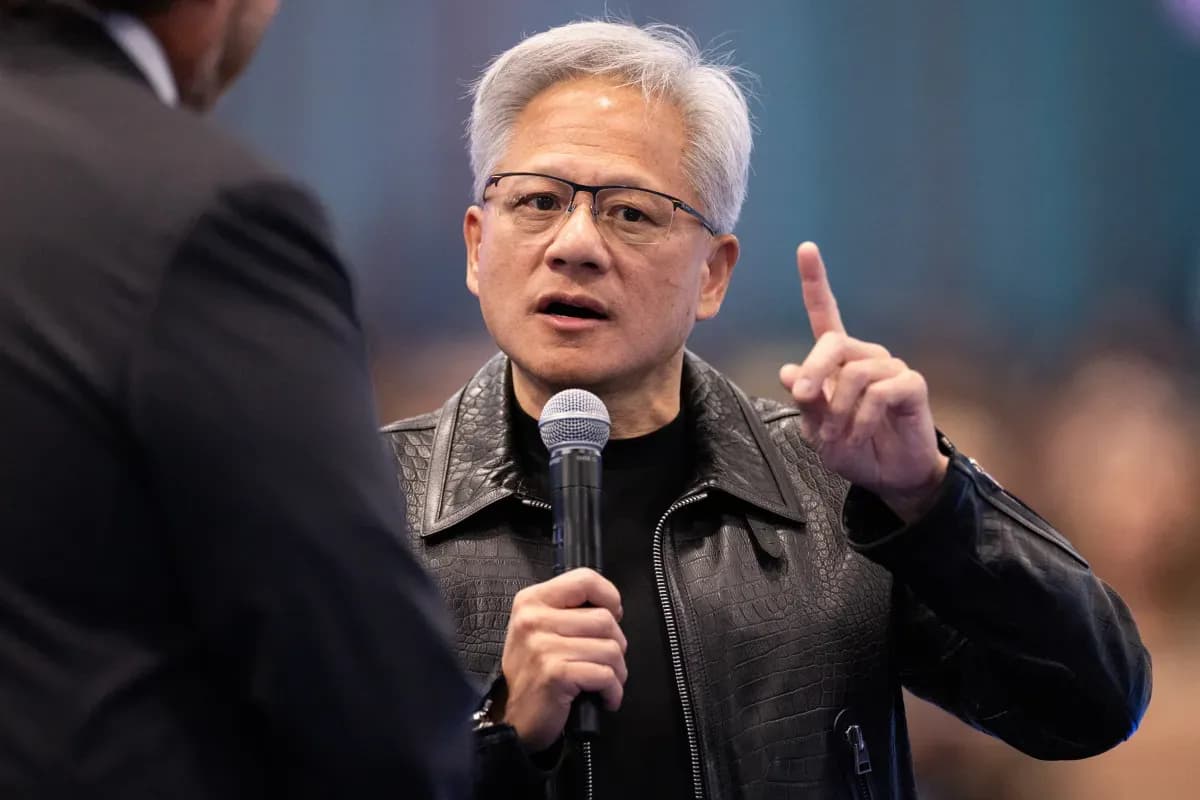
Summary of reporting by TechCrunchNvidia's board said it is opening an independent investigation into reports that founder and CEO Jensen Huang was the target of a foreign intelligence effort. A committee of independent directors, working with outside counsel, will run the review. The board said it has no reason to believe national security or company secrets were compromised, that the inquiry will examine all available information, and that Huang supports it. Reporting: TechCrunch https://techcrunch.com/2026/11/08/nvidia-says-its-investigating-ceo-jensen-huangs-relationship-with-possible-chinese-spy/ and The Verge https://www.theverge.com/ai-artificial-intelligence/1029562/nvidia-investigating-jensen-huang-relationship-chinese-spy
The same day, Nvidia published an email Huang sent to staff admitting to an affair. He apologised to his family and colleagues, said he had fallen short of his responsibility to the board, partners and shareholders, and said he would cooperate fully with the probe. The National obtained a copy of the message. https://www.thenationalnews.com/future/technology/2026/11/08/jensen-huang-email-affair-chinese-spy/
A US intelligence memo circulated earlier this year claimed that Alice Huang, an executive at Megaspeed, a Singapore-based Nvidia customer, was recruited by China's Ministry of State Security to spy on Nvidia's CEO. The Financial Times reported the memo described a romantic relationship. Nvidia had earlier said the pair's interactions were not unusual. Megaspeed is separately under US Commerce Department investigation over suspected smuggling of AI chips to China.
Huang has been asked to appear before a closed-door briefing with House committee chairs on 18 November, and is due to give Nvidia's GTC keynote in Washington on 30 November. Nvidia says he continues as CEO without interruption.
The Azrty take
In the AI economy the weakest link is no longer silicon. It is people, governance and who has unlogged access to the person at the top.
Strip out the personal scandal and this is a structural failure at the company at the centre of the AI supply chain. For CTOs, heads of data and AI, and boards in the UAE and the wider GCC, the question is not whether Huang keeps his job. It is whether the governance around your own AI programme would survive the same test: who has unlogged access to your roadmap, your model endpoints and your suppliers. Gulf sovereign AI builds and regional GPU buyers sit downstream of US export licensing and of Nvidia's trust position in Washington. Both are now in play.
The Megaspeed thread is the part GCC procurement teams should study hardest. Megaspeed, a Singapore data-centre firm, became the largest Southeast Asian buyer of Nvidia chips, with reporting of nearly 2bn US dollars routed through its Malaysian subsidiary. It is under US Commerce Department investigation over suspected chip diversion to China, and Singapore police confirmed investigations of their own. In a companion case, New Matrix, a Commerce-authorised buyer of advanced Nvidia chips, was found at its listed office to be a hollow shell. Approved-vendor lists and end-user certificates caught neither pattern. Compare that with the conditions the Bureau of Industry and Security attached to its 13 January 2026 rule opening case-by-case licensing for the Nvidia H200 and AMD MI325X: buyer export-compliance and customer screening, no reduction of capacity available to US customers, and independent third-party testing in the United States. See the BIS announcement https://www.bis.gov/press-release/department-commerce-revises-license-review-policy-semiconductors-exported-china. The final rule itself, published at 91 FR 1684 and effective 15 January 2026, adds the detail the summary leaves out: Know Your Customer screening of the ultimate consignee, a named list of remote infrastructure-as-a-service end users, a 50 percent ceiling on shipments to China and Macau measured against US volumes, and no remote access for restricted parties. Read it on the Federal Register https://www.federalregister.gov/public-inspection/2026-00789/revision-to-license-review-policy-for-advanced-computing-commodities. Those conditions are the emerging baseline for anyone handling advanced compute, including hosts in the Gulf.
The governance lesson is in the board's own wording. The board statement https://nvidianews.nvidia.com/news/statement-from-nvidia-board-of-directors says there is no reason to believe secrets were compromised while the inquiry will examine all available information, and Huang's message to the company https://nvidianews.nvidia.com/news/a-message-to-our-company admits he fell short of his duty to board, partners and shareholders. Nvidia's founder is at once CEO, chief lobbyist and a counterparty to the administration. Most corporate insider-risk programmes are built for lost laptops. Almost none cover the executive who meets regulators and counterparties with no relationship register, no minutes and no travel briefing. That gap is a board-level exposure, not an IT ticket. The frameworks already say so. NIST organises exactly this discipline in its AI Risk Management Framework https://www.nist.gov/itl/ai-risk-management-framework, govern, map, measure and manage, and the OWASP Top 10 for LLM Applications 2025 https://genai.owasp.org/llm-top-10/ ranks supply chain and excessive agency among the ten risks that matter most once agents start taking actions for themselves.
How we would approach it technically: collapse every model, agent and GPU access path onto one auditable plane. Put an OpenAI-compatible gateway such as our FastLLM Proxy in front of your own LLM servers and hosted providers so routing, budgets and access control live in one place, with every request carrying a named identity. Run agents and models on your own GPU servers in isolated spaces (Kuvryn AI), and put a person in the loop on privileged runs (Dhole). Add deployment-location and egress rules so compute cannot quietly serve an unsanctioned jurisdiction. An illustrative gateway policy follows.
Conceptual access policy on a single model gateway policy: identity: oidc # every request maps to a named human or service deny: - shared_api_keys - anonymous_admin_sessions budgets: daily_usd: 2000 per_team: true audit: log: [actor, model, tokens, source_ip, geo] retain_days: 365 egress: allowed_regions: [ae, sa, us] alerts: secops@client.ae
What to do now
- Put every LLM and agent call behind one gateway (FastLLM Proxy in front of your own servers and hosted providers) with OIDC identities, per-team budgets and actor logging. Ban shared API keys before December.
- Re-run counterparty diligence on every GPU, cloud and reseller supplier this month: named end user, fixed deployment location, no-re-export clauses, and BIS-style customer screening kept on record.
- Start a relationship register for executives who negotiate AI procurement or meet regulators and vendors: counterparties, meetings and outcomes. Brief people before travel and log it in one place.
- Move privileged agent runs behind human approval (Dhole) and isolate models and GPUs per team (Kuvryn AI). Keep an audit trail of who touched weights, data and prompts, and test that you can reconstruct a week of access on demand.