
NovaForge
AI software factoryAI agents write code on your own infrastructure. Only what passes gates they can’t bypass gets merged.
A self-hosted Git platform where AI agents pick up work in isolated runs. Quality gates and an independent review decide what gets merged.
Agents write code faster than anyone can trust it
Coding agents can now take on real work. Yet most teams still run them on a developer’s personal access and check the output by reading diffs. Nothing stops an agent pushing to the wrong branch, or calling its own work done. And for many organisations in the region, sending source code to a foreign cloud is simply off the table.
Why it’s built the way it is.
Gates the agent can’t get round
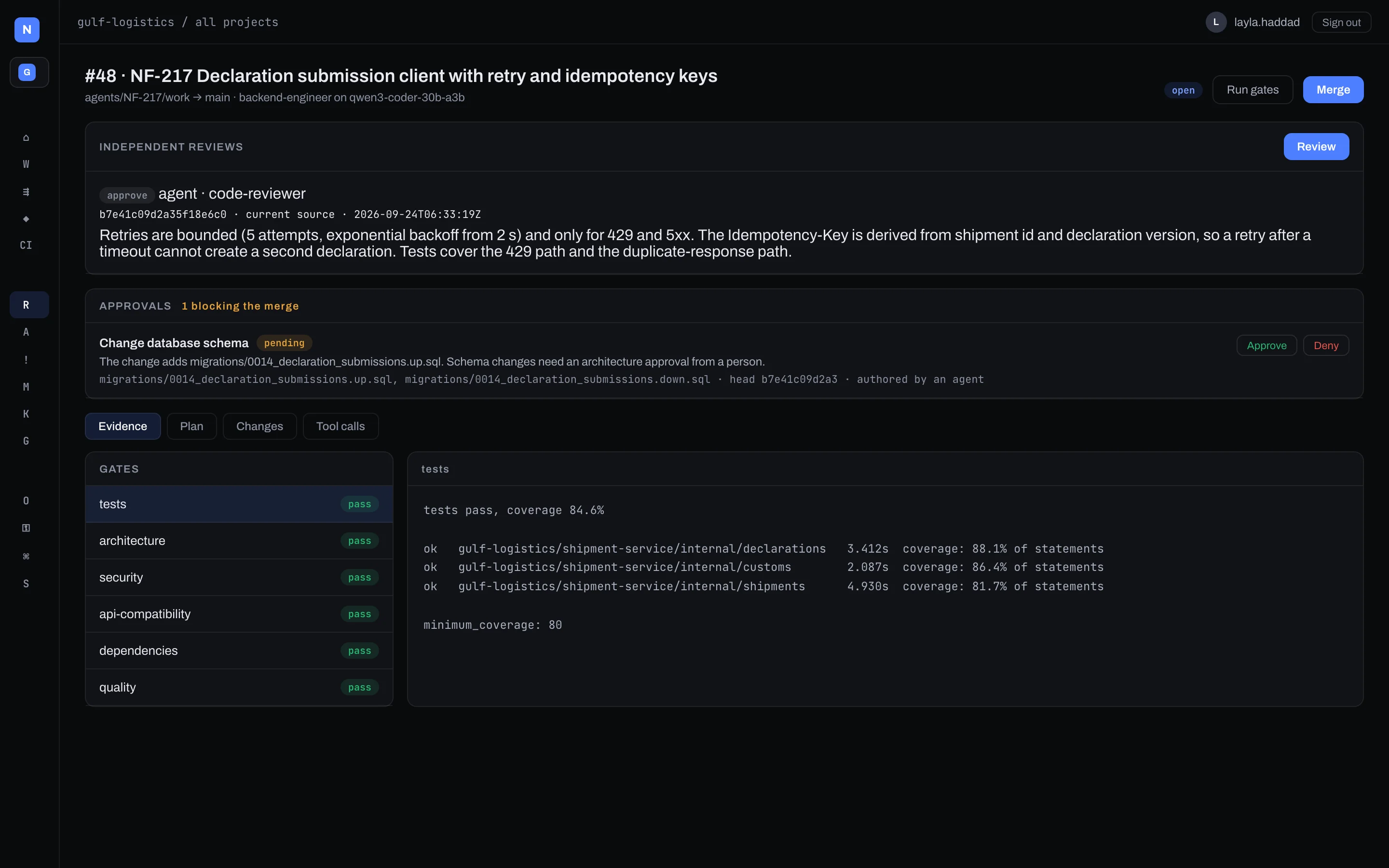
The platform runs the checks, not the agent: tests, architecture, security, dependencies and API compatibility. A change merges only once they pass and a different reviewer has signed it off.
Narrow permissions, actually enforced
An agent gets a capability grant for one Work Item. It can write to its own branch and nowhere else. The platform checks that on every tool call and every push, whatever the model asks for.
Evidence, not a summary
Each engineering run shows its plan and the measured impact and risk of the change. You also get the evidence from every gate and an audited list of the tool calls the agent really made.
Made for your own hardware
NovaForge is self-hosted. It reaches models through a single gateway that can point at local ones, and it’s designed to run with no internet access at all.
From setup to everyday use.
- 1
Describe the work
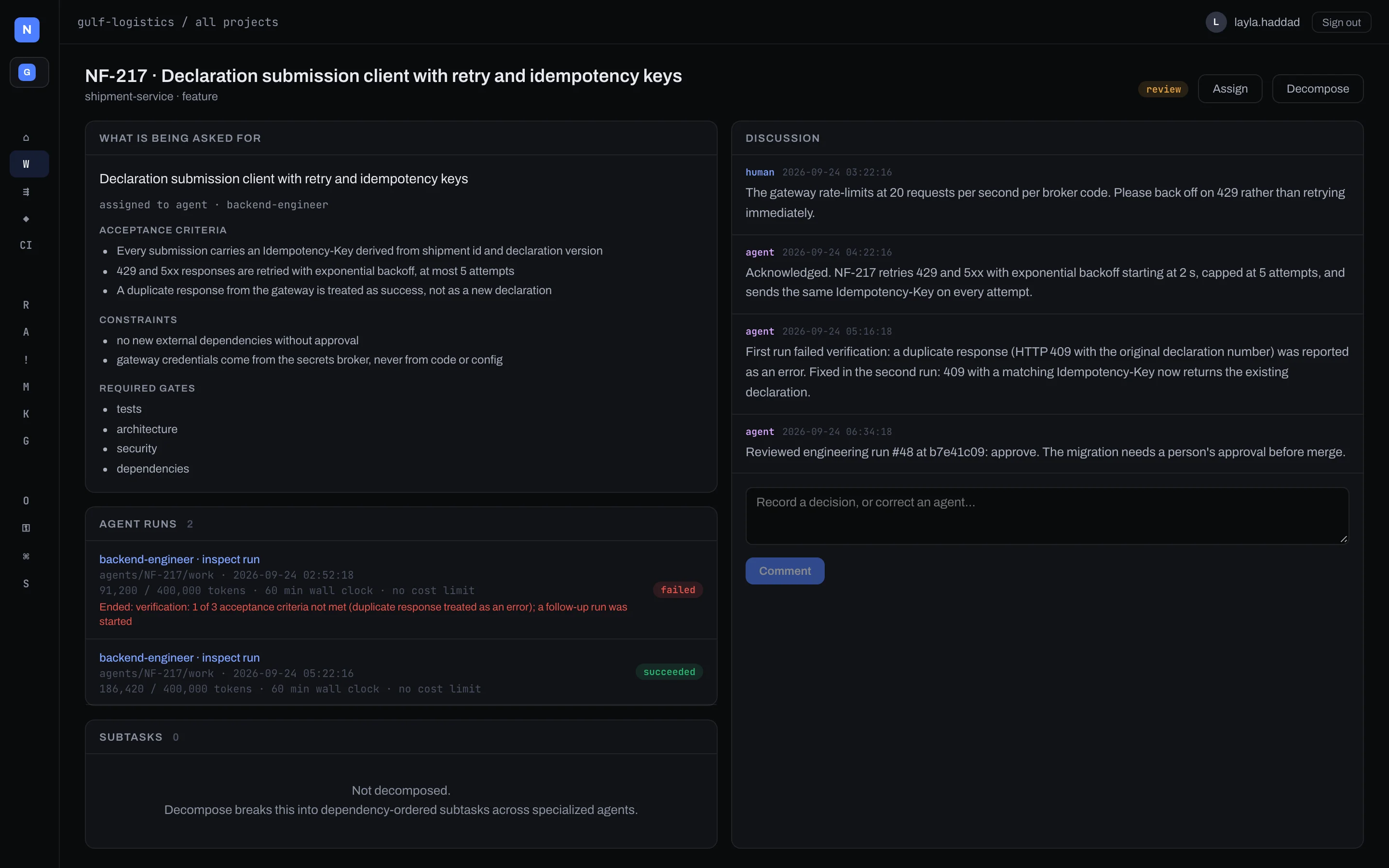
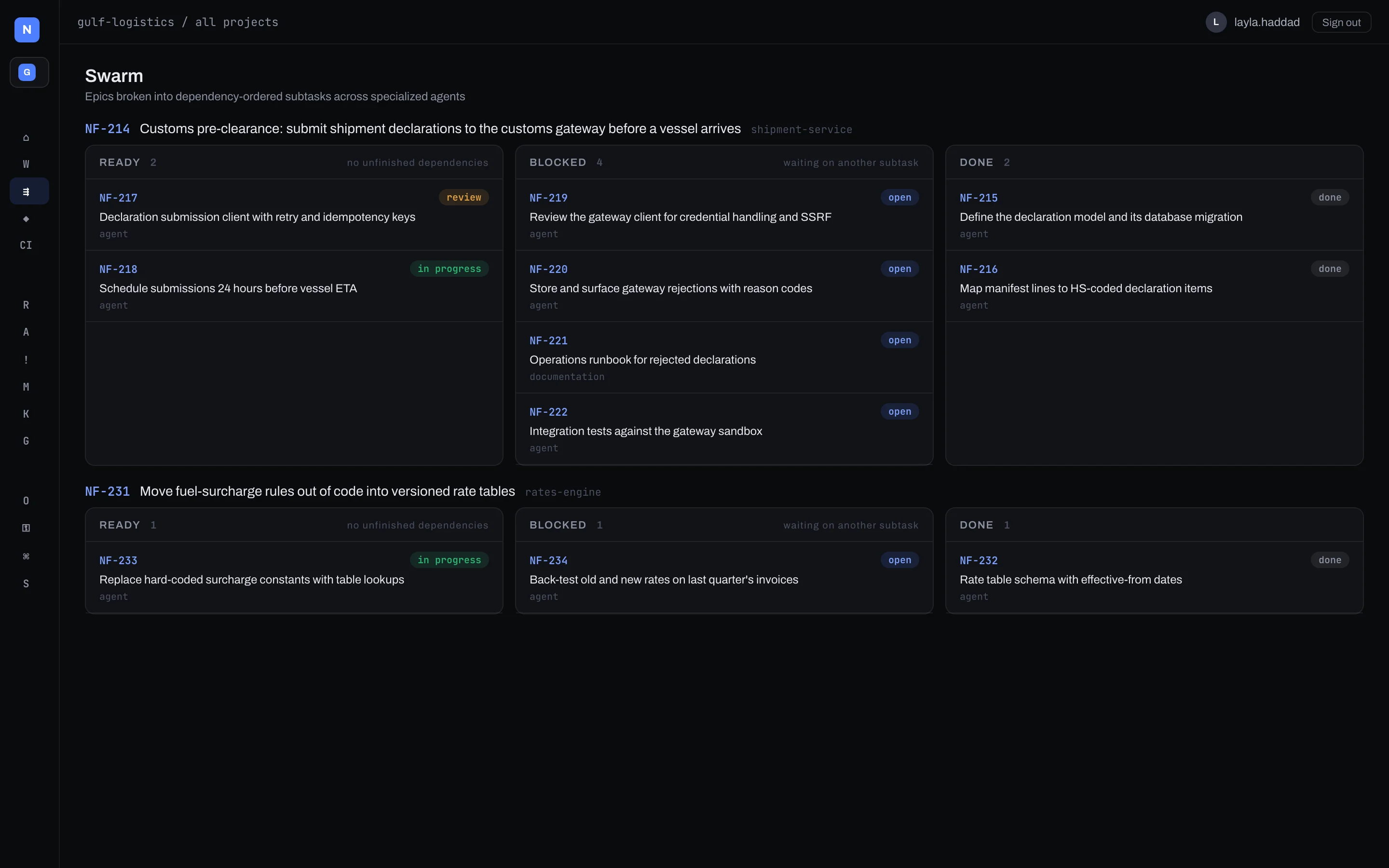
A Work Item sets out the goal and the acceptance criteria, plus the constraints and the gates it has to pass. The model can split a large item into subtasks, ordered by dependency.
- 2
Assign people or agents
Each subtask goes to a person or an agent. An agent run starts in its own isolated Kubernetes namespace, with limits on tokens and time, and a named person as its sponsor.
- 3
The agent works and commits
It reads the code, makes changes in its workspace, runs the tests and commits to its own branch. Every tool call is recorded. The result is checked against the acceptance criteria.
- 4
Gates, review, approvals
The platform’s gates check the run, and someone other than the author reviews it. Sensitive changes, a database schema change for instance, wait until a person approves them.
- 5
Merge
With gates, review and approvals all satisfied, the change merges to main with its evidence attached. The Work Item’s discussion keeps a record of the decisions made on the way.
See NovaForge at work.
What it does, in detail.
Git and work
- Standard Git hosting Clone, fetch and push over HTTPS and SSH from any ordinary Git client.
- Work Items Typed items (feature, bug, security, refactor and others), each with acceptance criteria, constraints and the gates it needs.
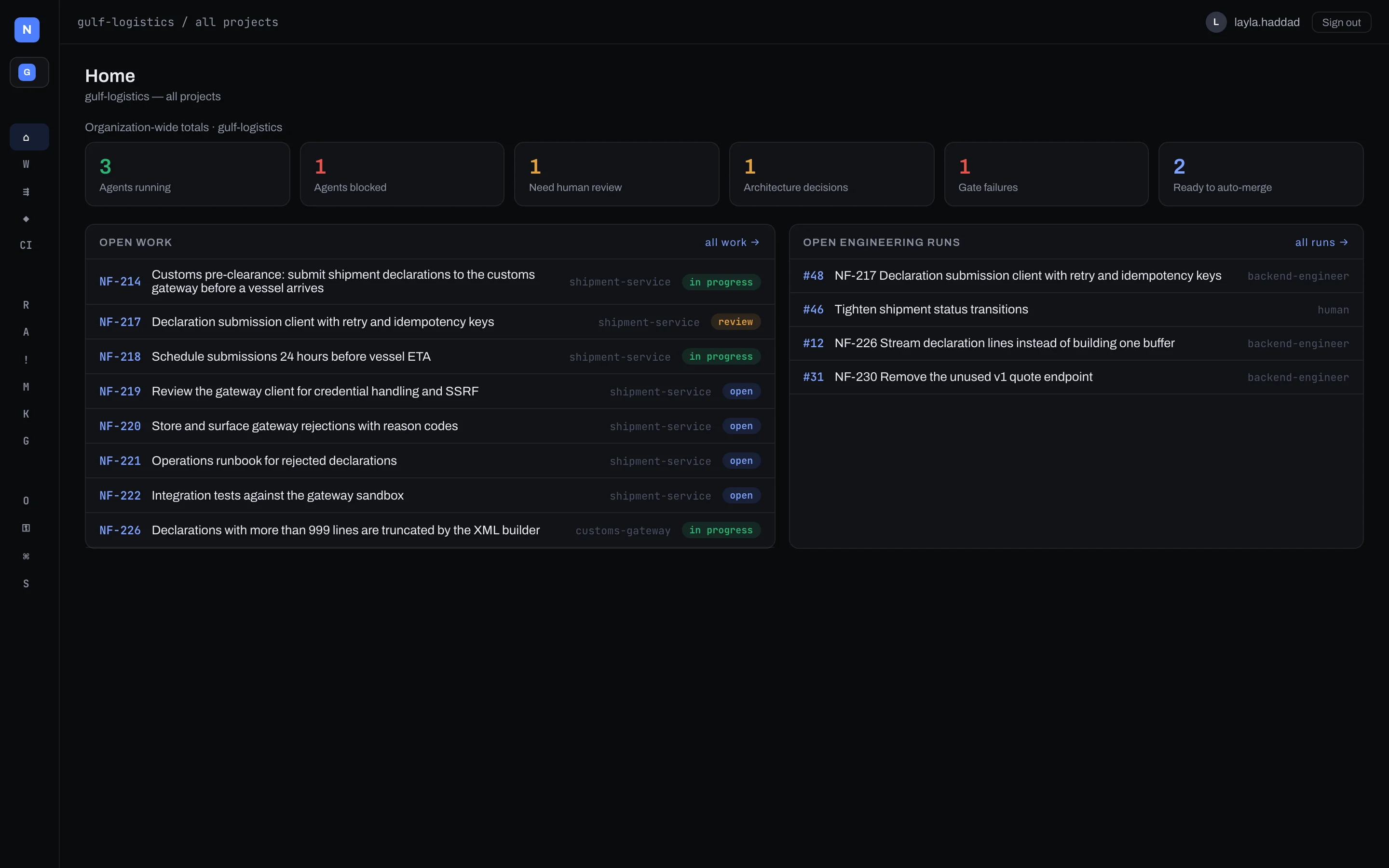
- Swarm view Every epic’s subtasks, sorted into ready, blocked and done. People and agents pick up work in the right order.
- Shared discussion One thread per Work Item. People correct agents there, and agents write down their decisions in it.
- Command-line client The nf CLI handles repositories, Work Items, agent runs, gates, review and merge.
Agents
- Isolated runs Every agent run has its own Kubernetes namespace and workspace. Both are removed when the run ends.
- Typed tools No open shell. Agents work through controlled tools such as repo.search, workspace.run and git.commit.
- Budgets Limits on tokens and wall-clock time for each run, and on cost where a model has a price.
- Agents in CI A CI job can be an agent role, a security review for example, running as a briefed and verified agent run.
- External tools through MCP An organisation can approve outside MCP servers for its agents. Each call is audited.
Governance
- Seven quality gates Tests with a coverage minimum, architecture rules, security, dependencies, API compatibility, code quality, and documentation.
- Independent review Nobody approves their own change. A second person or a reviewer agent has to, and any new push needs a fresh review.
- Approval rules Add a dependency, change the database schema or edit gate rules, and an approval is raised. The merge stays blocked until a person decides.
- Exceptions inbox People only see what needs them: blocked agents, failing gates, approvals waiting.
- Organisation boundaries Every query is scoped to the caller’s organisation. Credentials from one organisation reach nothing in another.
Knowledge and CI
- Search by meaning Code is indexed with embeddings. A search finds the right function even when it shares no words with what you typed.
- Engineering graph Dependencies, tests and history between symbols. Go has full coverage today.
- Project knowledge Decisions recorded in the project come back into later agent runs when they’re relevant.
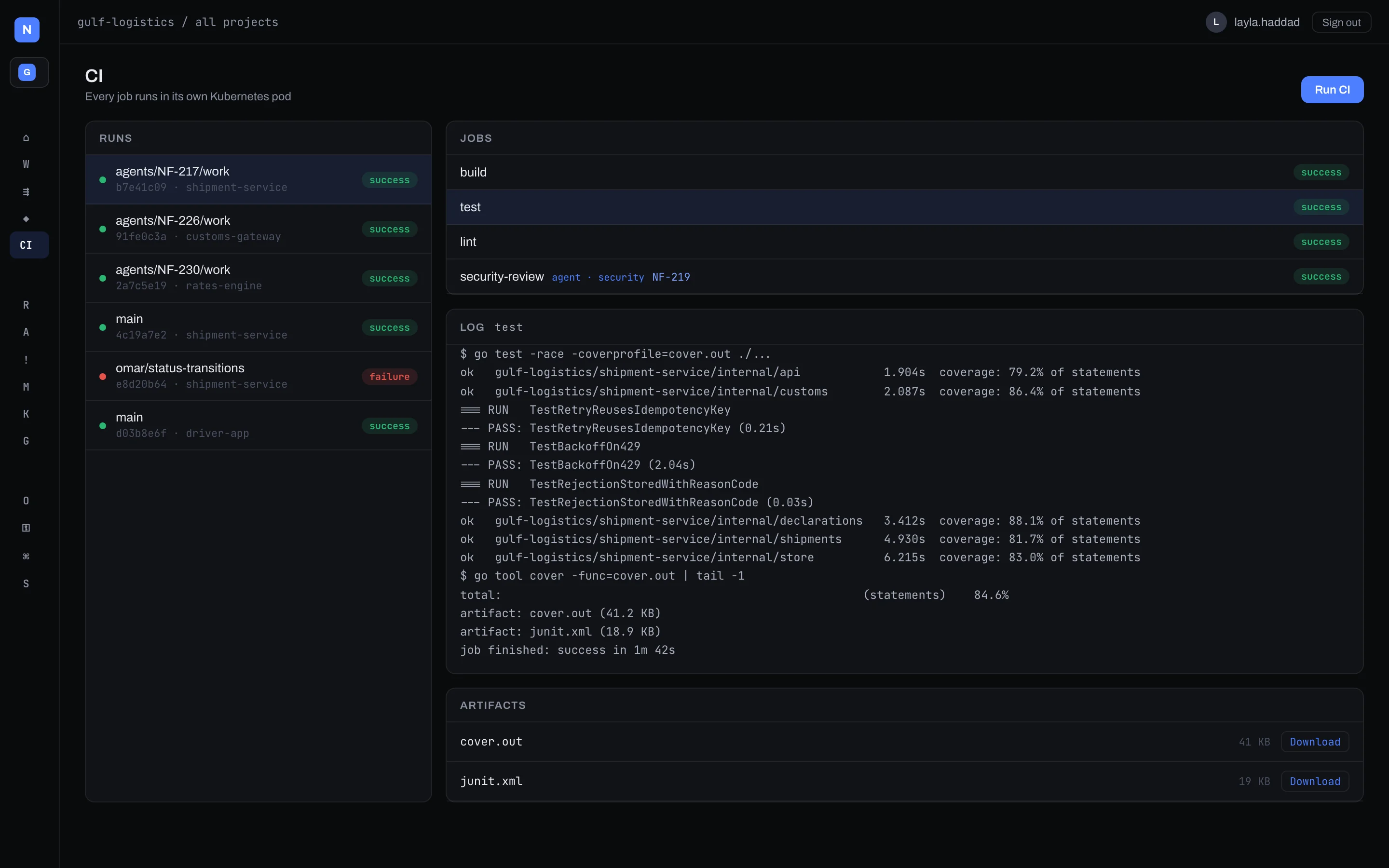
- Kubernetes CI Each CI job runs in its own pod. Logs are live and artifacts can be downloaded.
- Maintenance proposals Scheduled scans propose Work Items when coverage drops, performance regresses or the architecture drifts. A person approves them first.
Who uses it, and for what.
AI development without sending code abroad
Coding agents on your own servers, using local models, for code that has to stay inside your network or your country.
Clearing a backlog safely
Give agents the well-defined bugs, upgrades and refactors. Gates and review decide what reaches main.
Governed delivery for regulated teams
A full record of who or what changed each line and why, along with the evidence and approvals behind it.
At a glance
- Runs on
- Your own Kubernetes cluster (Helm chart), including environments with no internet access
- Requirements
- PostgreSQL with pgvector, Redis, S3-compatible object storage, an AI model gateway
- Models
- Any model behind the gateway, local or hosted; each agent can use a different one
- Integrates with
- Any Git client over HTTPS and SSH; MCP clients such as Claude Code; external MCP servers for agents
- Access
- Organisations and members, two-factor sign-in, personal tokens, SSH keys
- Built with
- Go services with gRPC, REST API with OpenAPI, React interface
Questions
Does our code or data leave our network?
Not unless you pick a hosted model. NovaForge runs on your cluster and only reaches models through the gateway you configure. That gateway can point at models on your own hardware.
Can an agent merge its own work?
No. The gates run outside the agent and the author of a change can’t approve it. Sensitive changes also need a person’s approval before anything merges.
Do our developers have to change how they work?
No. It’s standard Git over HTTPS and SSH. People keep their editors and Git clients, and pick up Work Items next to the agents.
Is NovaForge ready to use today?
Yes. The whole loop runs end to end on Kubernetes: Work Item, agent run, gates, independent review, merge. Book a demo and see it on your own projects.
How is it priced?
It depends on your team’s size and your deployment. Book a demo and we’ll put a proposal together.
AI that writes code to senior standards, with memory and context.
Procoder
Quality gates for AI coding agents. Work that is untested, unformatted or unfinished doesn't get to call itself done.
Learn moreKnowledge baseKryton
A self-hosted knowledge base with wiki links and a knowledge graph. Your team and your AI assistants read and write it together.
Learn moreAI memoryNovamem
A memory service for AI agents. They remember what matters between conversations, privately for each person or shared across a project.
Learn moreAI code reviewKuvryn Scout
Keeps reviewing your GitHub and GitLab repositories with standard analysers and AI rules, and files what it finds as issues without repeating itself.
Learn moreDeveloper SDKgo-ai-sdk
An open-source Go library for building AI features across 40 providers: text and streaming, structured output, tools, embeddings, images and speech.
Learn moreSee it on your own data.
We run the demo with your data, then propose a scope and pricing.