
Novamem
AI memoryEvery AI agent on your team remembers the same decisions, preferences and project facts.
A memory service for AI agents. They remember what matters between conversations, privately for each person or shared across a project.
AI agents forget everything
Every conversation with an AI agent starts from zero. People explain the same background again. Agents relearn the same conventions, and a decision made in one tool means nothing in the next. Whatever one colleague’s assistant picked up about a project never reaches anyone else on the team.
Why it’s built the way it is.
One memory, whatever the tool
Claude Code, Cursor, Codex and other agents read and write one shared memory over MCP or HTTP. Learn a fact in one tool and it’s waiting in the next.
Search on five signals at once
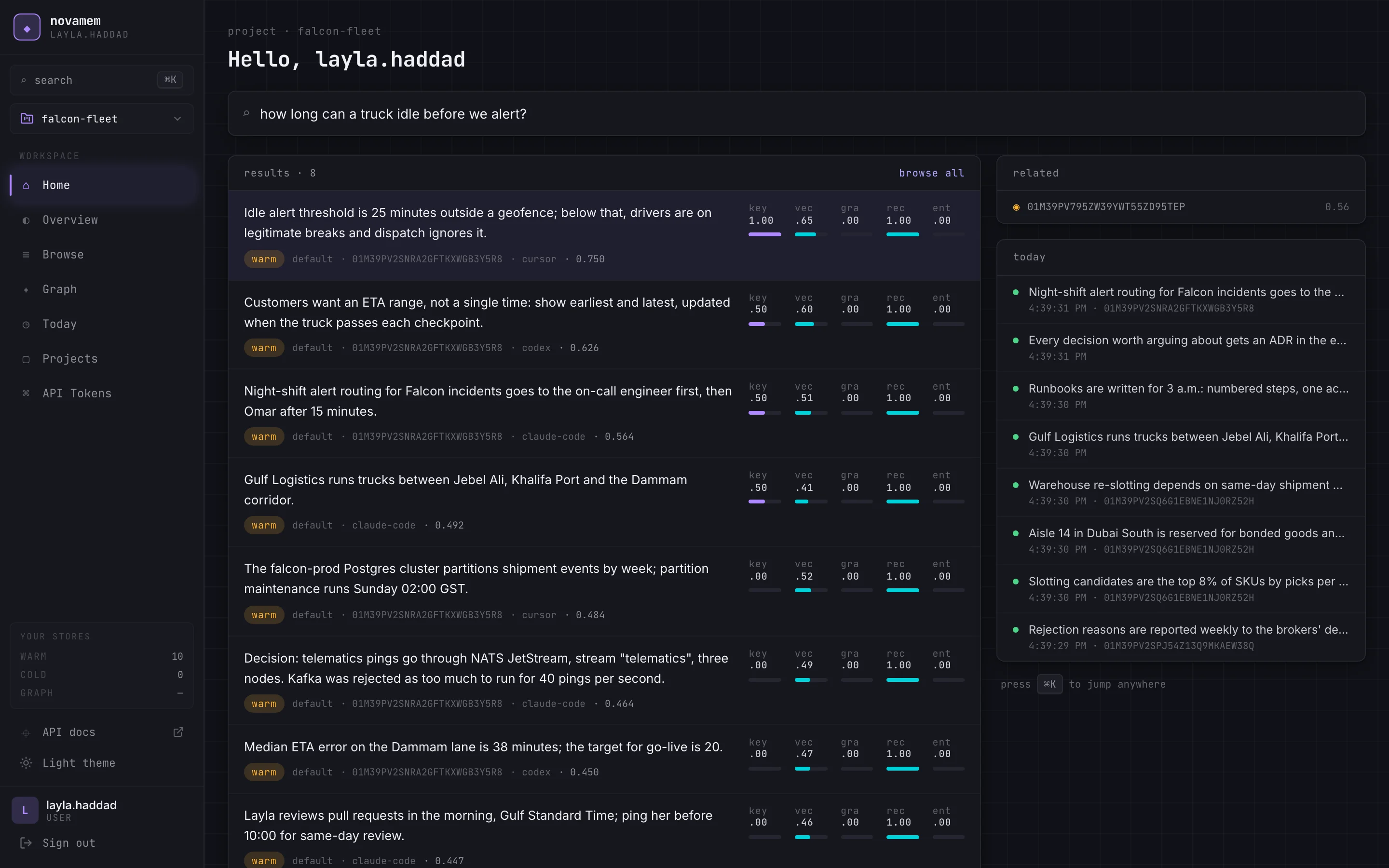
Keywords, meaning, links between memories, recency and named identifiers are scored together. Each result shows how much every signal counted.
Private by default, shared by project
Your own memory is yours alone. Project memories go to that project’s members and no one else.
Holds on to what’s true now
Duplicates get merged. When a new fact contradicts an old one, the old entry is marked superseded, so agents work from the current version.
From setup to everyday use.
- 1
Run the server
Deploy with Docker Compose or on Kubernetes, on Postgres with pgvector or Qdrant. Point it at whichever embedding model you like.
- 2
Connect the agents
A single command finds the AI tools on a computer and writes their MCP configuration, with a personal access token.
- 3
Agents remember as they work
Before a task, an agent pulls in relevant memories. Afterwards it saves the outcome worth keeping, noting the agent’s name and the sensitivity.
- 4
Share by project
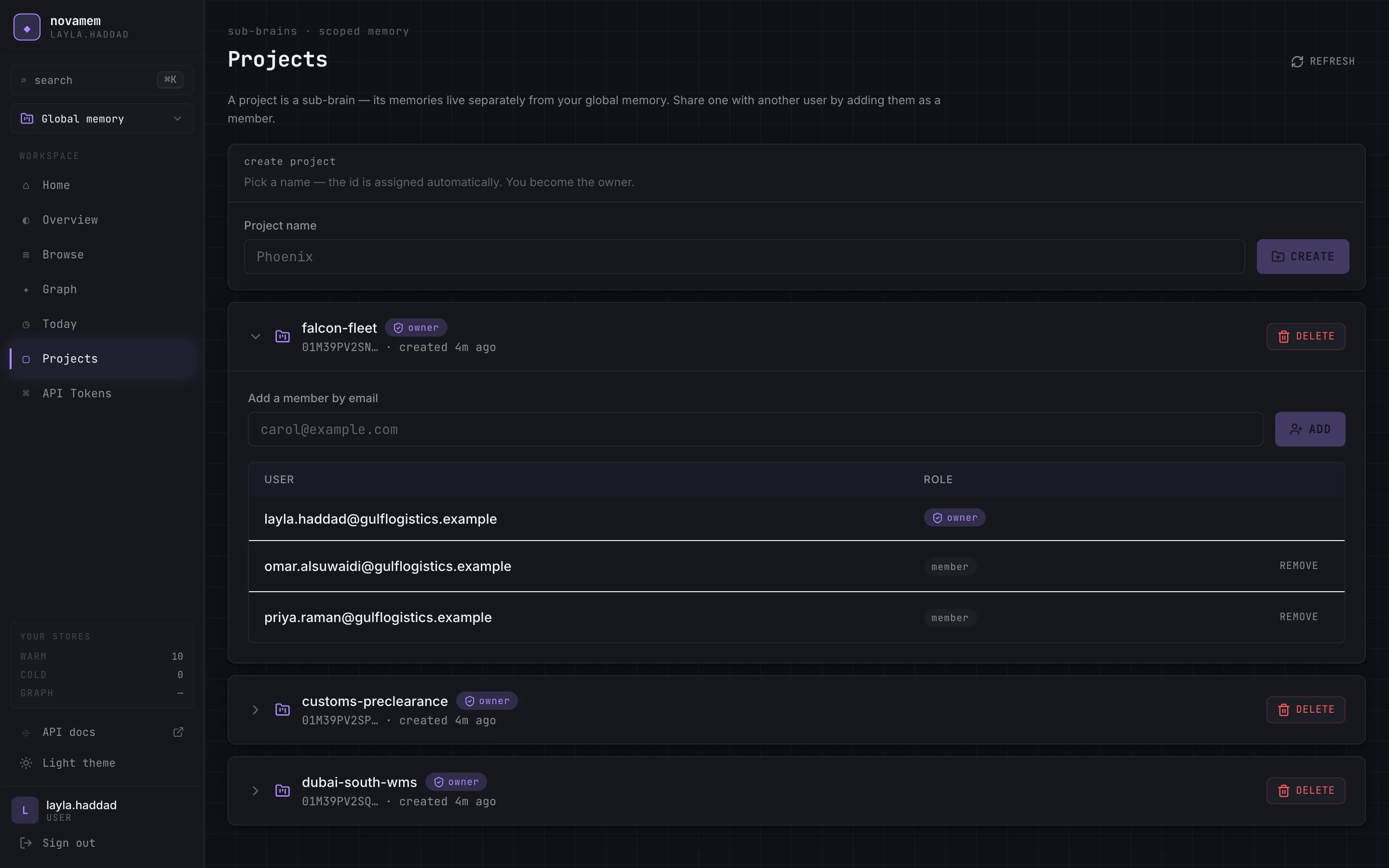
Create a project and add colleagues by email. From then on their agents read and write the same project memory.
- 5
Memory stays lean
Memories nobody uses drift from the fast tier to the vector tier over time, and can still be recalled. The ones in regular use stay warm.
See Novamem at work.
What it does, in detail.
Recall
- Hybrid search Full-text, vector, graph, recency and entity signals merged into one ranking. The weights can change per query.
- Context in one call At the start of a task an agent gets the relevant memories and the recent ones in one go.
- Time-based recall Ask what was remembered today, or since any date.
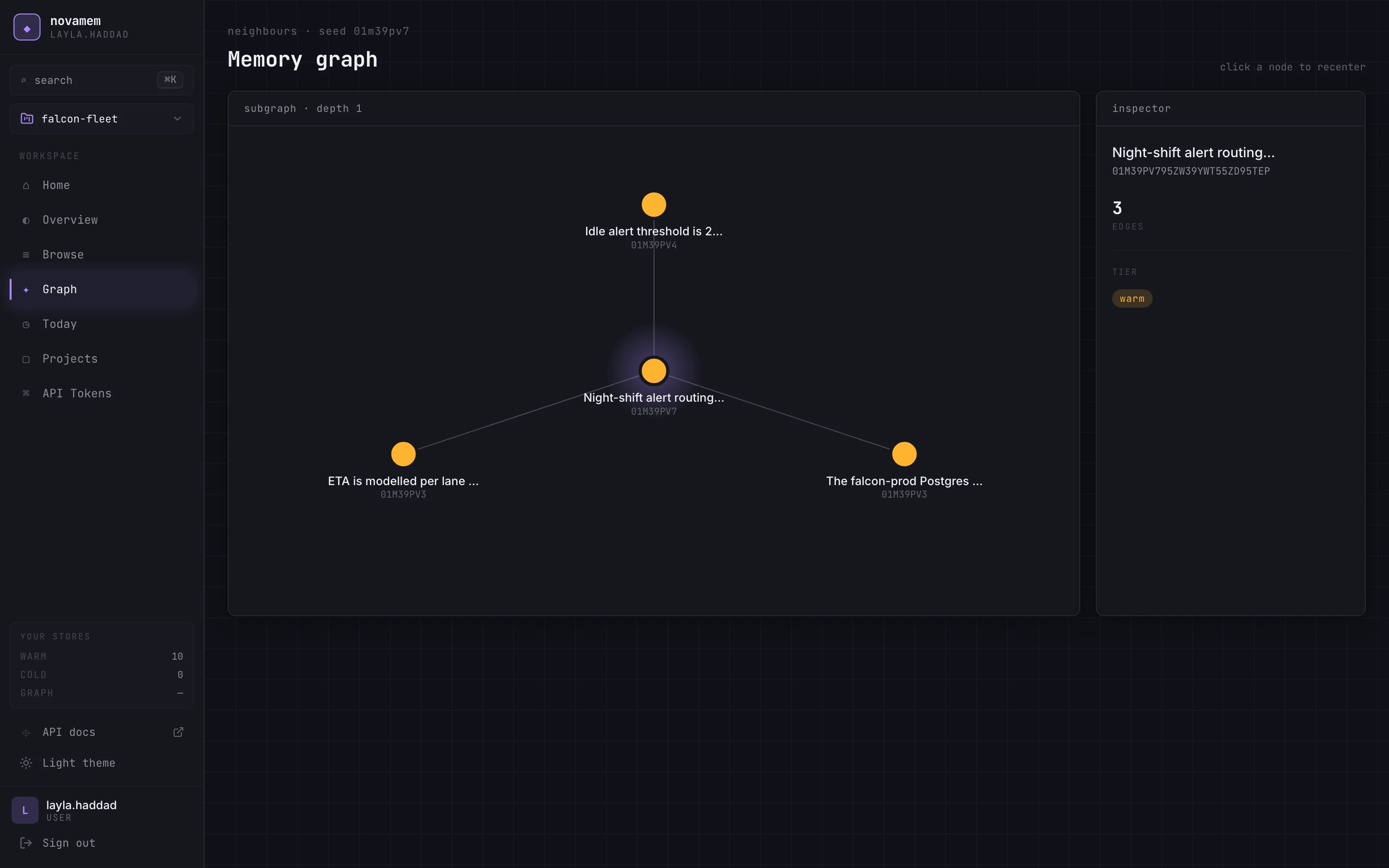
- Linked memories Memories that mention the same entities are linked. Agents can walk from one memory to its neighbours.
Writing and hygiene
- Worthiness gate Filler like "ok" or "thanks" is turned away before it’s stored.
- Duplicate handling An exact repeat returns the memory that’s already there. A near-duplicate updates it in place.
- Contradiction supersession A newer fact that contradicts an older one replaces it. The old entry stays for provenance but drops out of recall.
- Sensitivity levels Public, internal, private or sensitive. Sensitive entries stay out of recall unless someone asks for them explicitly.
- Provenance Every memory records the agent that wrote it, its source and how confident it is.
Teams and control
- Per-user isolation Each memory belongs to one user. The only way across is a shared project.
- Projects with members Sub-brains that owners share with named colleagues, and can take them off again.
- Scoped API tokens Full or read-only tokens for each agent and machine. Expiry is optional, and usage is tracked per token.
- Quotas and rate limits Caps on entries and writes for each user. A request limit for each client.
- Audit log Administrative actions, recorded so operators can review them.
Dashboard
- Search and browse Put a question to your memory and see the signal breakdown on each result. Or browse everything in a project.
- Memory graph See how memories connect, one neighbourhood at a time.
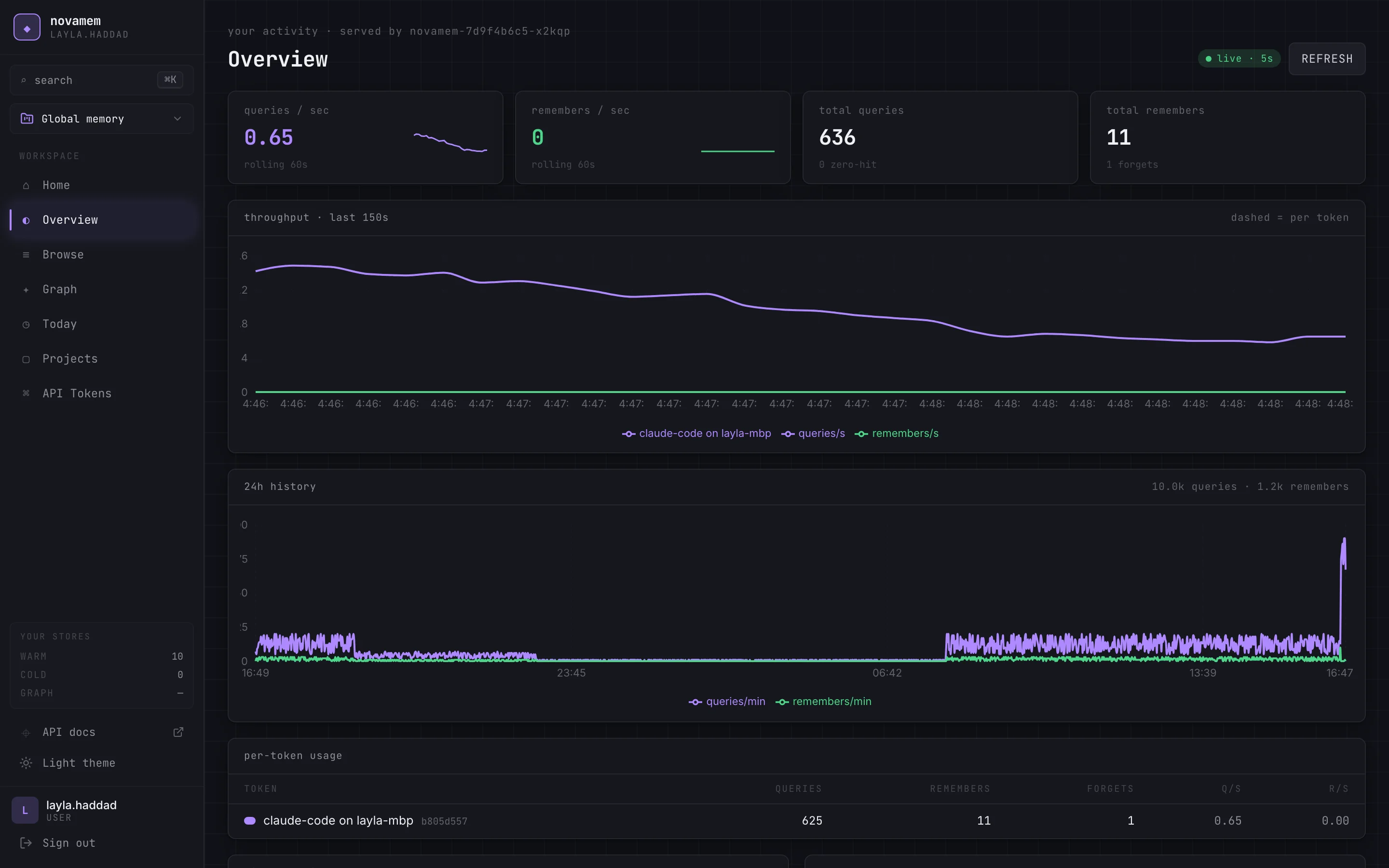
- Usage overview Live queries and saves per second, 24 hours of history, and usage for every token.
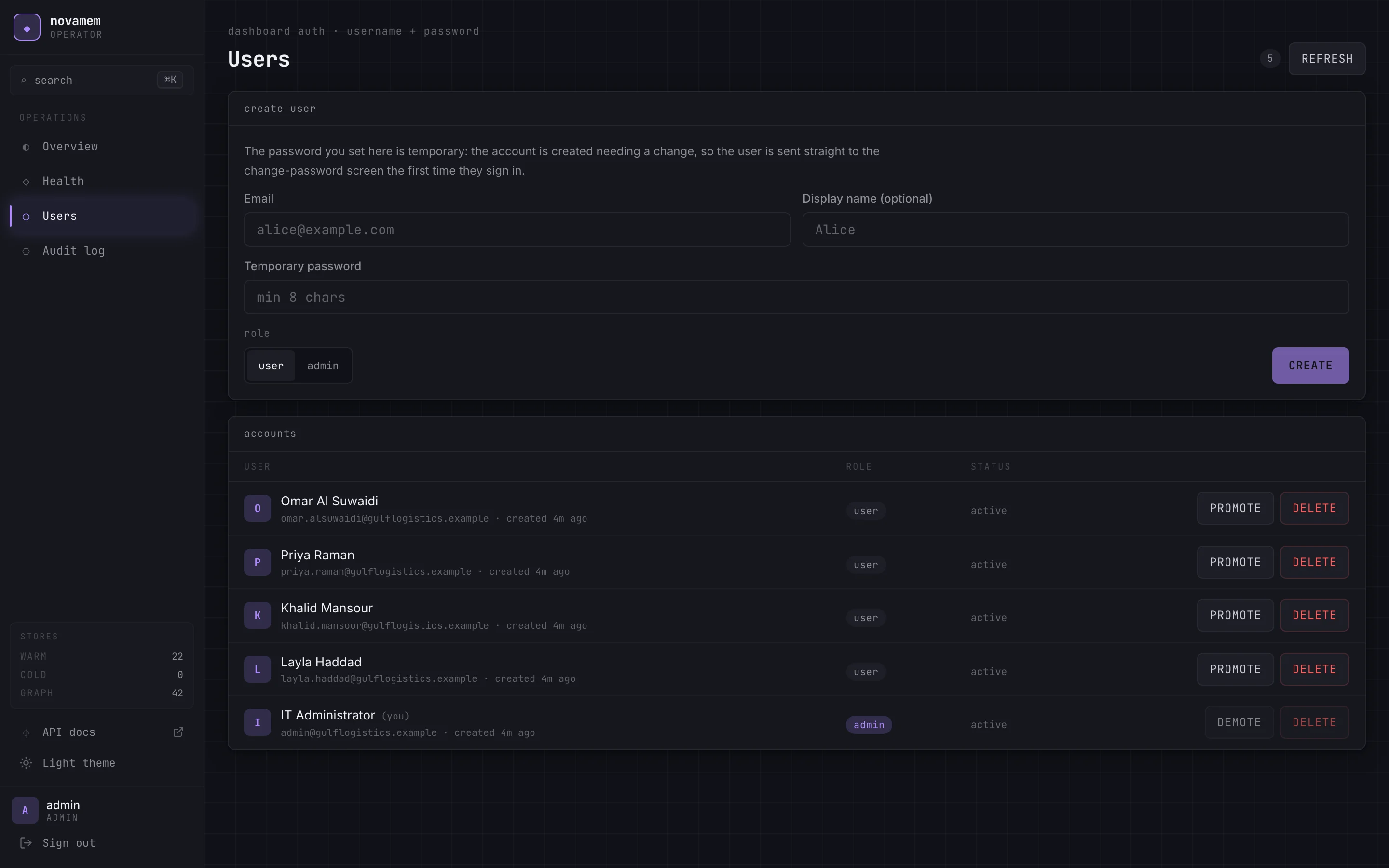
- Operator views For administrators: users, the health of every dependency, store sizes and the audit log.
Who uses it, and for what.
Engineering teams using AI agents
Coding agents remember the team’s conventions, its architecture decisions and the known pitfalls, in every developer’s tools.
Shared project context
Everyone on the project, and every agent they use, works from the same facts. Who owns what, which thresholds apply, what’s still undecided.
Personal assistant memory
Your preferences and way of working follow you from one AI tool to the next. Nobody else sees them.
At a glance
- Runs on
- Linux server or Kubernetes; a laptop for a single user
- Deployment
- Docker Compose or Kubernetes, on your own infrastructure
- Requirements
- Postgres, plus pgvector or Qdrant; an OpenAI-compatible embedding endpoint of your choice
- Integrates with
- MCP and HTTP clients, with setup for Claude Code, Claude Desktop, Cursor, Cline, Continue, Kilo Code and others
- Interfaces
- MCP, JSON HTTP API with OpenAPI spec, web dashboard
- Built with
- Go, Postgres, React
Questions
Where do our memories live?
In your own Postgres and vector store, on your own infrastructure. The embeddings come from the endpoint you configure, and that can be a model you host yourself.
Can one person’s agent see another person’s memories?
No. Personal memory is visible to its owner only. Project memory is visible to the project’s members, and to nobody else.
What stops agents filling it with noise?
Several things. A gate turns filler away and repeats get merged. Contradicted facts are superseded, and memories nobody uses leave the fast tier over time.
How is it priced?
It depends on scope: how many users, and the deployment and support you need. Book a demo and we’ll size it with you.
AI that writes code to senior standards, with memory and context.
Procoder
Quality gates for AI coding agents. Work that is untested, unformatted or unfinished doesn't get to call itself done.
Learn moreKnowledge baseKryton
A self-hosted knowledge base with wiki links and a knowledge graph. Your team and your AI assistants read and write it together.
Learn moreAI code reviewKuvryn Scout
Keeps reviewing your GitHub and GitLab repositories with standard analysers and AI rules, and files what it finds as issues without repeating itself.
Learn moreAI software factoryNovaForge
A self-hosted Git platform where AI agents pick up work in isolated runs. Quality gates and an independent review decide what gets merged.
Learn moreDeveloper SDKgo-ai-sdk
An open-source Go library for building AI features across 40 providers: text and streaming, structured output, tools, embeddings, images and speech.
Learn moreSee it on your own data.
We run the demo with your data, then propose a scope and pricing.