Jensen Huang resigns as Nvidia CEO; Colette Kress interim as board probes China-linked conflicts
Nvidia's co-founder and CEO resigned on 12 November 2026, with CFO Colette Kress as interim chief, after a board investigation into alleged conflicts of interest. For GCC AI builders the question is not the gossip: it is allocation, export licences and a tested second inference path.
What happened
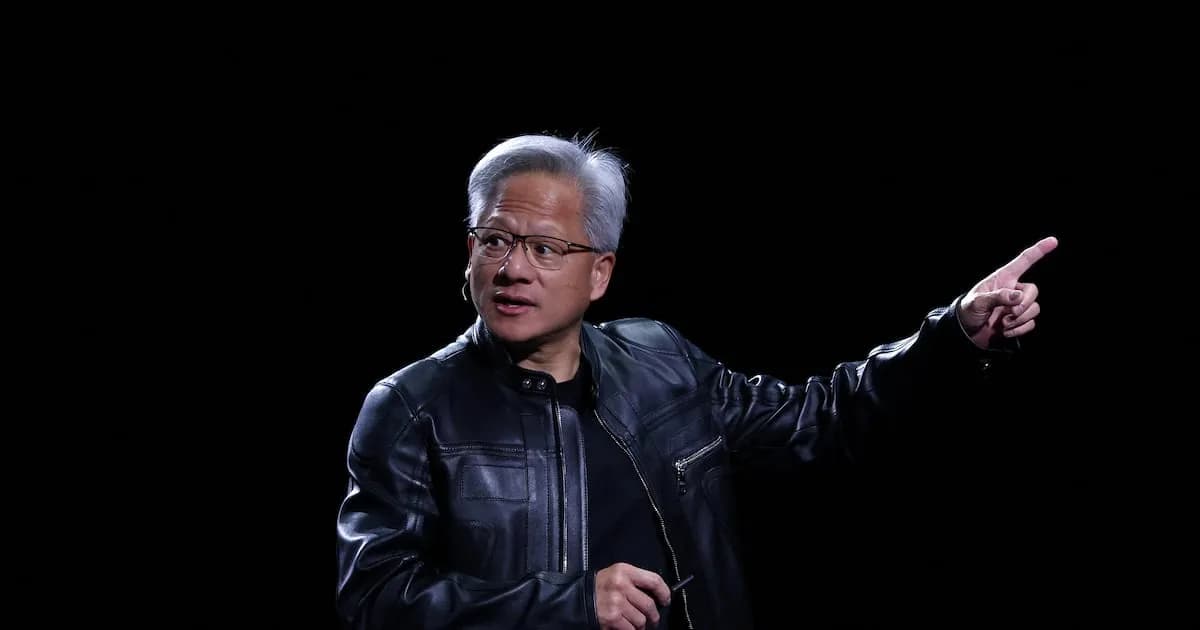
Summary of reporting by The NationalOn 12 November 2026 Nvidia's board accepted Jensen Huang's resignation as president, chief executive and director, effective immediately. CFO Colette Kress is interim CEO and president, and Harvey C. Jones becomes the company's first board chair. The National reported the transition and its fallout (https://www.thenationalnews.com/future/technology/2026/11/12/jensen-huang-resigns-nvidia-affair/). Huang has agreed to testify before Congress, and Democrats opened a second congressional investigation into Nvidia's China sales.
The trigger is a special committee investigation into alleged conflicts of interest: Huang's personal relationships with Nvidia personnel and third parties, including a woman described as a suspected PRC intelligence operative and a second Nvidia executive. Reuters later reported a third claim involving an Nvidia employee (https://www.theverge.com/ai-artificial-intelligence/1030422/nvidia-jensen-huang-ai-china-alice-huang). The US attorney general has said the Department of Justice has not concluded whether the woman was a Chinese spy.
The market reaction was sharp. TechCrunch put the premarket share fall at about 11.7 per cent (https://techcrunch.com/2026/11/12/jensen-huang-is-out-at-nvidia-who-is-colette-kress-his-interim-replacement/), and roughly $1.4 trillion of market value went with it. Forrester calls the episode a stress test for the AI boom and tells CIOs to confront concentration risk (https://www.forrester.com/blogs/nvidias-leadership-crisis-dont-overreact-confront-your-ai-concentration-risk/). Semafor reports the fallout could slow the Gulf's AI buildout as Saudi Arabia's HUMAIN and the UAE's G42 compete harder for chip access (https://www.semafor.com/article/11/12/2026/fallout-from-nvidia-ceos-likely-ouster-could-slow-gulf-ai-buildout).
Nvidia's $12.9 billion agreement to acquire Hugging Face is now in question, and Hugging Face's chief executive has said he will keep fighting for open source AI. Companies linked to the woman at the centre of the investigation reportedly invested in DeepSeek's second funding round and pledged to supply restricted Blackwell chips.
The Azrty take
Nvidia's leadership crisis turns single-supplier AI concentration into a board-level risk for GCC builders, and most teams will answer it with a token second model instead of a real second path.
The soap opera is not the story. The story is that the supplier underneath almost every sovereign AI roadmap in the region lost its founder mid-generation. Nvidia's governance, its allocation policy and its export licence position sit on the critical path of Gulf platforms built on HUMAIN and G42 capacity, and all three are now in the hands of an interim CEO and a first-time board chair. A personnel story has become a supply story, and that finally gives CIOs the board-level argument for diversification they have wanted for a year.
Two live threads show the range of exposure. The export-control one: companies linked to the woman at the centre of the investigation reportedly invested in DeepSeek's second funding round and pledged to supply restricted Blackwell chips (The Verge). If your allocation depends on a licence, your roadmap depends on a policy process you do not control. The open-weights one: when Nvidia announced the $12.9 billion deal for Hugging Face on 3 September 2026, it committed in its own words to keep the platform open, to let developers choose their models, frameworks, clouds and computing platforms, and to support multi-cloud and multi-accelerator deployment, with Nvidia compute not required to build on or deploy through Hugging Face (https://blogs.nvidia.com/blog/nvidia-to-acquire-hugging-face/). That commitment now rests with people who did not make it. Hugging Face's chief executive has said he will keep fighting for open source AI regardless. Treat it as a dependency to pin, not a policy to trust.
Most teams will get the response wrong. A second model behind the same Nvidia estate, or a second cloud reselling the same GPUs, is concentration risk with extra steps. A real second path means inference can move: across your own GPU estate, to at least one independent provider, and to a documented open-weights fallback such as DeepSeek R1, a 671B-parameter mixture-of-experts model with 37B active parameters, a 128K context window and an MIT licence that permits commercial use and derivative works, served either locally through vLLM or SGLang or through an OpenAI-compatible API (https://huggingface.co/deepseek-ai/DeepSeek-R1). Switching cost is lowest at the inference layer, which is exactly where your next request for proposal should land.
Our approach at Azrty is to put an OpenAI-compatible control plane in front of every model call, so routing, budgets and access control live in one place whatever happens to a supplier. That is what FastLLM Proxy does in front of your own LLM servers and 80 hosted providers, and Kuvryn AI runs agents, models and GPUs as a service on your own GPU servers, so the estate stays yours. The policy shape we deploy looks like this (illustrative, not product syntax):
routes:
  default: own-gpu-estate        # your reserved GB300/H200 or self-hosted capacity
  fallbacks:
    - hosted-provider-a          # any OpenAI-compatible endpoint
    - open-weights-r1            # self-hosted, mirrored model revision
controls:
  budgets: per_team_monthly
  approvals: human_signoff_for_side_effects
  logging: full_request_audit
  pinning: model_revisions_and_sdk_versions
Our team in the UAE does this end to end: architecture, deployment and support. The opportunity in this crisis is to turn procurement from a single-vendor bet into a portfolio with a tested fallback, and to get export-control and re-export language into contracts while vendors are motivated to sign. The risk is waiting for Congress, a permanent CEO or the next allocation call to make the decision for you. Nvidia's product advantage is probably secure for a generation; your allocation, your pricing and your ability to route around a shock are not.
What to do now
- Write down which workloads depend on Nvidia hardware or allocation, and what changes if supply, pricing or export terms shift. Treat interim CEO Colette Kress's first guidance as a procurement checkpoint, not a news item.
- Put an OpenAI-compatible gateway (FastLLM Proxy or equivalent) in front of every model call: two providers minimum, one self-hosted open-weights fallback such as DeepSeek R1, per-team budgets and access control switched on, and SDK versions pinned.
- Pin Hugging Face dependencies to specific model revisions and mirror anything mission critical while the $12.9 billion acquisition is unresolved. Confirm that inference workloads can actually move between hardware platforms, where switching costs are lowest.
- Ask legal to re-read export-control and re-export clauses in GPU and cloud contracts, and record a named fallback supplier for every critical AI dependency.